Here’s a scenario that plays out in optical shops daily: a parent brings in their 8-year-old, optician recommends polycarbonate lenses, the parent asks “why can’t we just use the standard ones?” — and the optician struggles to explain that standard CR-39 plastic shatters on impact, polycarbonate flexes, and the difference could matter if a baseball or lacrosse ball connects with those glasses. Then the Trivex option comes up and the parent’s eyes glaze over completely.
Let’s cut through the confusion. Here’s exactly what you’re buying, what each costs, and when the upgrade is worth it.
The Three Main Single-Vision Lens Materials
| Material | Refractive Index | Abbe Value | Impact Resistance | Lens-Only Upcharge |
|---|---|---|---|---|
| CR-39 (standard plastic) | 1.50 | 58 (excellent clarity) | Low — shatters | Baseline |
| Polycarbonate | 1.586 | 30 (fair clarity) | Highest — ANSI Z87 certified | +$30–$80 |
| Trivex | 1.53 | 45 (good clarity) | High — ANSI Z87 certified | +$50–$120 |
| High-index 1.67 | 1.67 | 32 (fair) | Low to moderate | +$100–$200 |
| High-index 1.74 | 1.74 | 33 (fair) | Low to moderate | +$150–$300 |
The “Abbe value” — a measure of how well a lens refracts light without splitting it into rainbow-like color fringing — is the key optical quality metric. Higher is better. CR-39 at 58 is optically excellent. Polycarbonate at 30 is noticeably lower — people with stronger prescriptions or sensitive optics sometimes notice color aberration, especially at the lens periphery.
Polycarbonate: The Safety Standard, With a Trade-off
Polycarbonate became the default safety lens material because it’s genuinely tough. It was originally developed for aircraft canopies and astronaut helmets. An ANSI Z87 certified polycarbonate lens won’t shatter into shards when struck — it flexes and may crack, but it stays largely intact.
The AAO recommends polycarbonate or Trivex for all children’s lenses, active adults in sports, and anyone with only one functional eye. The recommendation is based on injury prevention data — eye injuries from broken standard plastic lenses are preventable.
The cost premium: $30–$80 per lens at most optical shops, or $15–$40 total for lenses at online retailers. The pediatric case is straightforward — the upgrade is worth it without much deliberation.
The Abbe value trade-off (30 vs. 58) is real but it affects patients differently:
- Mild-to-moderate prescriptions (under ±3.00): Most wearers notice no difference in clarity
- Stronger prescriptions (beyond ±4.00): Some patients notice peripheral color fringing with polycarbonate
- High astigmatism: The Abbe value effect is most noticeable and may reduce optical comfort
Trivex: Better Optics, Similar Safety, Higher Price
Trivex was developed in 2001 as an optical-grade safety material. It’s slightly less impact-resistant than polycarbonate (though still ANSI Z87 certified), but it has a substantially better Abbe value (45 vs. 30). It’s also lighter than polycarbonate — meaning more comfortable for all-day wear.
The case for Trivex over polycarbonate:
- Strong prescription where optical clarity matters more
- Light, thin frames where lens weight affects fit
- Patients who’ve noticed color fringing in polycarbonate before
- Adults who want safety lens properties without the optical compromise
The cost premium: $50–$120 over standard CR-39, or $15–$40 more than polycarbonate at comparable quality levels. Complete pairs run $50–$150 more than a polycarbonate pair.
Standard CR-39: Adults with moderate prescriptions (±3.00 or under), low-activity lifestyles, no children, no sports. Best optical clarity for the price.
Polycarbonate: All children (required by most AAO and AOA guidelines), monocular patients (one functional eye), active adults in contact sports, safety glasses for industrial use. The cost is low and the risk protection is real.
Trivex: Adults who want safety lens properties with better optical quality — especially those with prescriptions beyond ±3.00, active adults who’ve noticed chromatic aberration in polycarbonate, or anyone who values lighter lenses for comfort.
High-index materials: Strong prescriptions where thinness and cosmetics are the priority. Trade optical clarity for aesthetics — reasonable choice for adults in non-impact environments.
Kids’ Lenses: Why Polycarbonate (or Trivex) Isn’t Optional
The American Academy of Ophthalmology’s clinical guidelines explicitly state that children’s corrective lenses should be polycarbonate or Trivex. This isn’t a soft recommendation — it’s a safety standard based on the higher activity level of children and the documented incidence of eye injuries from broken standard plastic lenses.
Some optical shops offer polycarbonate automatically for children and won’t accept waivers for standard plastic. If yours doesn’t raise the issue proactively, raise it yourself. The $30–$80 per lens upgrade is one of the most clearly justified costs in pediatric eye care.
What the Full Cost Comparison Looks Like
For a child with moderate myopia (-2.50, no astigmatism) in a mid-range frame:
| Option | Lenses | Frames | Total |
|---|---|---|---|
| CR-39 standard (not recommended for kids) | $40 | $80 | $120 |
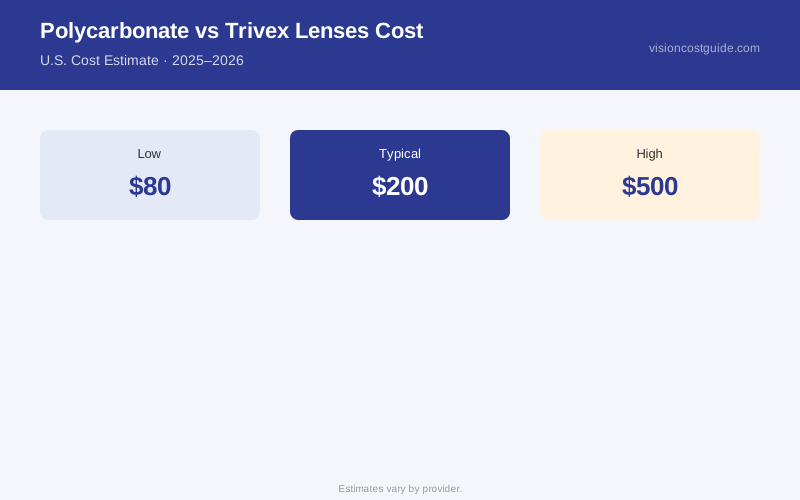
| Polycarbonate | $70–$120 | $80 | $150–$200 |
| Trivex | $90–$160 | $80 | $170–$240 |
| Polycarbonate online (Zenni, etc.) | $20–$40 | $20–$40 | $40–$80 |
Not all polycarbonate lenses are created equal. “Polycarbonate” is a material standard — the optical quality can vary depending on how carefully the lab cuts and coats the lens. If you’re choosing polycarbonate partly for optical quality and partly for safety, ask your optician specifically about the lab they use and whether their polycarbonate lenses come with quality AR coating. Uncoated polycarbonate reflects more light and has more visible aberration than coated versions.
Bottom Line
For most children and active adults, polycarbonate is the right answer — it’s safer than standard plastic, the cost premium is modest, and the optical difference is negligible for most prescriptions. For patients with stronger prescriptions or those who’ve noticed optical issues with polycarbonate, Trivex is worth the $15–$40 additional premium for meaningfully better optics with comparable safety. Standard CR-39 remains the best optical clarity choice for adults in low-impact environments who don’t need the safety properties.