You had cataract surgery two years ago. Your vision was crisp and clear. Now it’s cloudy again — and you’re wondering if the cataract came back. It didn’t. What you’re experiencing is posterior capsule opacification (PCO), and it affects roughly one in three cataract surgery patients within two years of their procedure. The good news: it’s completely treatable, usually in under 10 minutes.
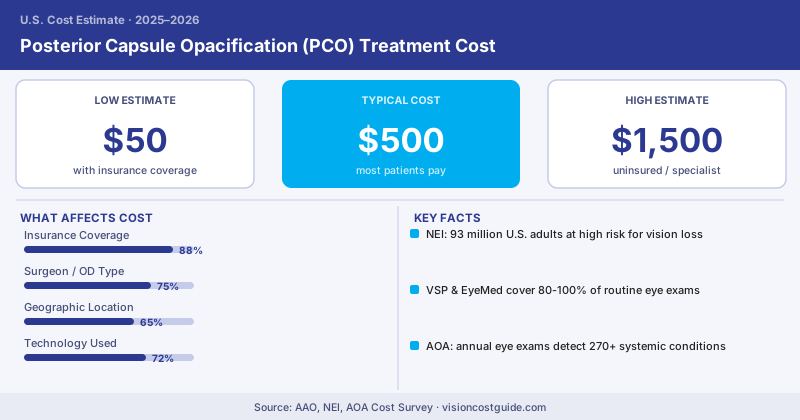
The cost? $300–$1,500 per eye out-of-pocket without insurance, or roughly $50–$200 with Medicare. Here’s everything you need to know.
Why Does PCO Happen?
During cataract surgery, your surgeon removes the cloudy natural lens but leaves behind the thin membrane (capsule) that held it. The new intraocular lens (IOL) is placed inside that capsule. Over time, residual lens epithelial cells migrate across the back surface of the capsule and multiply, causing it to turn hazy. The result is vision that progressively blurs, much like the original cataract.
The American Academy of Ophthalmology (AAO) estimates that PCO develops in roughly 20% of patients within 2 years and up to 50% within 5 years of cataract surgery. It’s one of the most common complications — or more precisely, sequelae — of the most commonly performed surgery in the U.S.
PCO is more common with older IOL materials (PMMA) than modern hydrophobic acrylic IOLs, but it can occur with any lens design. Younger patients and those with certain eye conditions are at higher risk.
Treatment: YAG Laser Capsulotomy
The standard treatment is Nd:YAG laser capsulotomy — a quick, painless in-office procedure that creates a small opening in the hazy capsule. Light can then pass clearly through the new opening, and vision typically improves within hours.
One session is almost always sufficient. The capsule doesn’t re-haze once the opening is made.
PCO Treatment Cost
| Scenario | Cost Range |
|---|---|
| Medicare Part B (with Medigap) | $0–$75 |
| Medicare Part B (no supplement) | $80–$200 |
| Commercial insurance (in-network) | $100–$400 |
| Self-pay, in-office | $300–$900 |
| Self-pay, ambulatory surgery center | $700–$1,500 |
| Second eye (if needed) | Same cost range per eye |
Insurance Coverage
PCO treatment is covered by Medicare and major commercial health plans because it’s a direct complication of a covered surgery (cataract removal). It’s billed under CPT 66821 (laser surgery for secondary cataract).
- Medicare Part B: Pays 80% after the Part B deductible. With a Medigap plan, your cost may be near zero.
- Commercial plans: Covered under the medical benefit. Check your deductible and coinsurance — some high-deductible plans may mean you pay the full allowed amount if you haven’t met your deductible yet.
- Vision plans: Do NOT cover PCO treatment. It’s a medical procedure, not a routine vision service.
PCO treatment is sometimes incorrectly coded by billing staff as an elective refractive procedure, which insurers deny. The correct code is CPT 66821 (discission of secondary membranous cataract). If your claim is denied, ask your ophthalmologist’s billing team to confirm the code and submit a clinical appeal with your post-surgical records showing the diagnosis of PCO.
What to Expect at the Appointment
The entire visit typically lasts 30–60 minutes, though the laser itself takes only 5–10 minutes:
- Your eyes are dilated with drops (plan for blurry vision for 3–5 hours after).
- A numbing drop is applied.
- A special contact lens is placed on your eye to stabilize it and direct the laser beam.
- The laser makes 10–30 pulses to create the capsule opening — you’ll see bright flashes.
- Your pressure is checked 30–60 minutes later to monitor for IOP spike.
Most patients notice improved vision the same afternoon. Some see more floaters temporarily as small capsule fragments drift in the vitreous — this usually settles within a few weeks.
Rare Risks to Know
PCO laser is extremely safe, but complications exist:
- IOP spike: Temporary pressure elevation in the hours after treatment. Usually self-limiting; your doctor may prescribe a pressure-lowering drop as a precaution.
- Retinal detachment: Very rare (estimated 0.1–0.3%) but more likely in highly myopic eyes or those with pre-existing peripheral retinal weakness. Tell your ophthalmologist if you’re highly nearsighted before the procedure.
- Damage to the IOL: The laser can pit the surface of some IOL types if the opening isn’t positioned carefully. This is uncommon with modern technique.
After a YAG capsulotomy, if you suddenly see a new curtain, shadow, or dramatic increase in floaters — especially within the first few weeks — call your eye doctor immediately. While retinal detachment after PCO treatment is rare, it requires emergency evaluation. Don’t assume new symptoms are normal recovery.
Can PCO Be Prevented?
Modern hydrophobic acrylic IOLs (like the AcrySof platform from Alcon) have a sharp posterior optic edge design that creates a mechanical barrier to cell migration, reducing PCO rates significantly compared to older lens materials. Some IOL designs claim to reduce PCO rates by 80% compared to older lenses.
If you’re still planning cataract surgery or choosing your IOL, ask your surgeon about PCO rates for the specific lens they’re recommending. It’s a worthwhile question.
Bottom Line
Posterior capsule opacification is common, predictable, and completely treatable. With Medicare or solid commercial coverage, your out-of-pocket cost is typically $80–$400. Self-pay patients should expect $300–$900 in most in-office settings. The procedure takes minutes, the results are immediate, and it’s one of the safest interventions in ophthalmology. If your vision has gone cloudy after cataract surgery, don’t wait — schedule the evaluation.