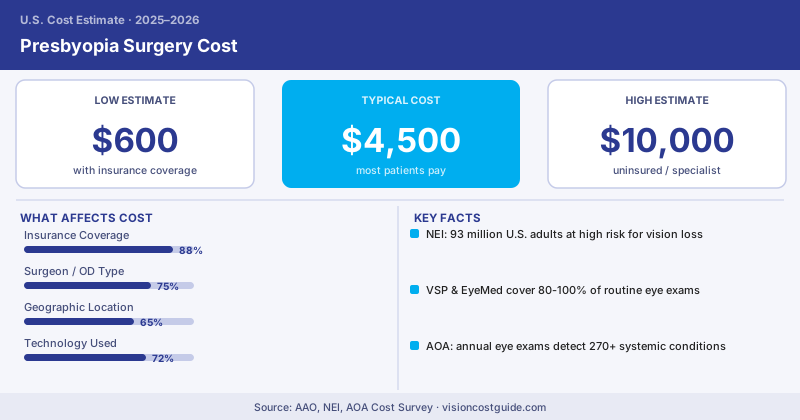
Reading glasses at 45. That’s the deal most Americans quietly make with aging. But in 2025, you don’t have to. Multiple surgical and pharmaceutical options now treat presbyopia—the loss of near-focus that hits virtually everyone in their mid-40s. Prices vary wildly.
Here’s how to think about what each option is actually worth.
The Scale of the Problem
Presbyopia affects 100% of adults who live past their mid-40s. The AOA reports that by 2050, over 2.1 billion people worldwide will have presbyopia. In the US, it’s estimated that Americans spend over $15 billion annually on reading glasses, bifocals, and progressive lenses—most of it recurring cost, year over year.
That’s the benchmark for comparing any surgical intervention: not just what it costs today, but what it saves over 10–20 years.
Treatment Cost Comparison
| Treatment | One-Time Cost |
|---|---|
| Reading glasses (OTC) | $15–$50/pair; ~$50–$150/year |
| Progressive (no-line bifocal) glasses | $300–$1,200/pair |
| Monovision LASIK | $3,000–$5,500 (both eyes) |
| Blended Vision LASIK (PresbyLASIK) | $4,000–$6,500 |
| KAMRA corneal inlay | $3,500–$5,500 per eye |
| Vuity (pilocarpine 1.25% drops, daily) | $600–$900/year (ongoing) |
| Refractive Lens Exchange with multifocal IOL | $5,000–$10,000 (both eyes) |
| Refractive Lens Exchange with EDOF IOL | $5,000–$9,000 (both eyes) |
Monovision LASIK: Best Value for Most Patients
Monovision LASIK corrects one eye for distance and one for near, letting the brain blend both inputs. It sounds strange. For 70–80% of patients who trial it in contact lenses first, it works remarkably well.
Cost: $3,000–$5,500 for both eyes, comparable to distance LASIK pricing. Best suited to patients with mild-to-moderate presbyopia who haven’t yet had LASIK and still have adequate corneal tissue.
The crucial test: try monovision with contact lenses for 2–4 weeks before committing to surgery. Your surgeon can trial this for $50–$150 in contact lens fitting fees. If you hate it, you haven’t committed to anything.
KAMRA Inlay: High Cost, Mixed Results
The KAMRA corneal inlay ($3,500–$5,500 per eye) is a tiny ring implanted in the non-dominant eye, creating a small-aperture (pinhole) effect that extends near focus depth. Early adopters had mixed results—some found reading dramatically improved; others experienced halos, reduced contrast, or dissatisfaction requiring removal ($1,000–$2,500 to explant).
KAMRA has largely fallen out of favor at most major refractive surgery centers, replaced by better-performing approaches. If a surgeon is pushing this heavily in 2025, it warrants a second opinion.
Vuity: Daily Drops That Work (For Some)
Vuity (pilocarpine 1.25%) received FDA approval in 2021—the first eye drop specifically for presbyopia. It constricts the pupil, increasing depth of focus for 3–6 hours. Clinical trials showed about 30% of patients achieved two or more lines of near vision improvement.
Cost: $75–$80/month (roughly $900/year). The math: over 10 years, you’d spend $9,000—more than monovision LASIK. Vuity also causes dim-lighting vision reduction (pupil constriction), headaches in some patients, and doesn’t work for everyone.
Best use case: patients who aren’t surgical candidates and want an on-demand reading boost for specific activities.
Refractive Lens Exchange (RLE) removes the natural crystalline lens and replaces it with a synthetic IOL—simultaneously eliminating presbyopia, any existing myopia/hyperopia, and the future need for cataract surgery. For patients 50+, this is arguably the most comprehensive vision correction surgery available. Cost: $5,000–$10,000 for both eyes with a multifocal IOL. Not covered by insurance until it’s classified as cataract surgery—but multifocal IOL upgrade costs ($1,000–$3,000 per eye) are never covered.
How to Choose Based on Your Situation
Under 50, good corneas, myopic: Monovision LASIK is likely your best value. Trial monovision contacts first.
Under 50, hyperopic or never had LASIK: PRK monovision or blended vision is an option; LASIK may not be suitable depending on corneal thickness.
50–60, early cataract changes, or thick lenses: RLE becomes attractive—you’ll need cataract surgery eventually anyway.
65+: Medicare will cover cataract surgery (standard monofocal IOL) when cataracts impair vision. Upgrading to multifocal or EDOF IOLs runs $1,000–$3,000 per eye out-of-pocket.
Insurance Reality
Virtually no insurance covers elective presbyopia correction. Monovision LASIK, KAMRA, and RLE for presbyopia alone are cosmetic procedures. Exceptions: RLE that’s performed as cataract surgery gets basic coverage; the premium IOL upgrade does not.
Use HSA or FSA funds—all medically supervised eye procedures qualify. Many LASIK/refractive practices offer 18–24 month 0% financing through CareCredit or Alphaeon Credit.
The Bottom Line
Over a 10-year horizon, $75/month in Vuity drops costs $9,000 and still requires glasses for some tasks. Monovision LASIK at $4,000–$5,000 pays for itself in 4–5 years versus progressives and is permanent. For most presbyopic patients without contraindications, surgical correction is genuinely cost-effective—not just convenient.