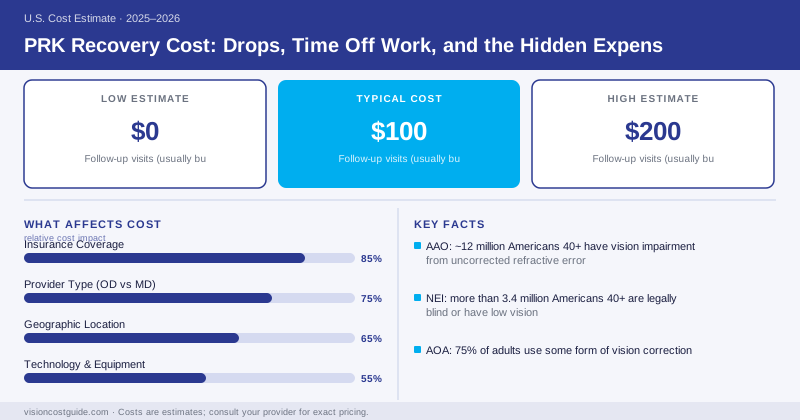
42% of the discomfort people remember from PRK happens in the first 72 hours — when the cornea’s surface layer is regrowing. That’s the trade-off baked into PRK: the procedure itself often costs about the same as LASIK, but recovery is longer, and it carries its own price tag of roughly $100–$500 in drops, supplies, and time off work.
If you’re choosing PRK, budgeting for recovery matters as much as budgeting for surgery.
PRK Recovery Cost Breakdown
| Recovery Item | Typical Cost |
|---|---|
| Prescription eye drops (antibiotic + steroid) | $50–$200 |
| Bandage contact lenses (usually included in surgery fee) | $0–$50 |
| Preservative-free artificial tears (weeks of heavy use) | $30–$80 |
| Pain relief (OTC or short-course prescription) | $10–$40 |
| Time off work (3–7 days typical) | Varies |
| Follow-up visits (usually bundled in surgery fee) | $0 |
These costs sit on top of the PRK surgery fee itself. The biggest real-world cost for many people isn’t the drops — it’s the days of work they need to take.
Why PRK Recovery Costs More Than LASIK Recovery
In LASIK, the surgeon makes a flap, lifts it, lasers underneath, and lays it back down — so vision returns in a day or two. PRK skips the flap and instead removes the cornea’s thin outer layer (the epithelium) entirely, lasers the surface, and lets that layer regrow over several days.
That regrowth is why PRK recovery is slower and more uncomfortable. A bandage contact lens protects the eye while it heals, and most people feel significant light sensitivity, tearing, and irritation for three to four days.
Plan for real downtime. Functional vision after PRK typically returns in one to two weeks, with full sharpness taking one to three months as the surface fully stabilizes — compared to LASIK’s one-to-two-day turnaround. The ASCRS and AAO both note that final visual outcomes for PRK and LASIK are equivalent; PRK just takes a longer, bumpier road to get there. Block out a long weekend plus a few light-duty days, and you’ll be far happier with the experience.
The Time-Off Question
This is the recovery cost people underestimate. For the first three to five days you’ll likely be light-sensitive and your vision will be hazy. If your job involves driving, screens, or fine detail, you probably can’t work normally during that window.
Smart scheduling: have surgery on a Thursday or Friday so you recover over a weekend, and plan two to three additional light-duty days. Self-employed or hourly workers should factor lost income into the true cost.
Do not cut your steroid drops short to save money or because the eye feels better. PRK relies on a carefully tapered steroid schedule to prevent corneal haze — stopping early is a known cause of haze that can blur vision and may require retreatment. If drop cost is a barrier, ask for generics or a pharmacy discount card rather than skipping doses.
Why People Choose PRK Despite the Recovery
Given the tougher recovery, why pick PRK over LASIK? Usually because of the cornea:
- Thin corneas that can’t safely support a LASIK flap
- Active lifestyles or jobs (military, contact sports, law enforcement) where a flap could be dislodged by impact
- Dry eye tendencies that LASIK can worsen
Our LASIK vs. PRK comparison breaks down which procedure fits which eyes and lifestyles.
Paying for Recovery
Drops and tears are out-of-pocket but HSA/FSA-eligible. Bandage lenses and follow-ups are usually bundled into your surgery fee — confirm this before booking so there are no surprises. Ask whether your quoted price includes the full post-op visit schedule.
Bottom Line
PRK recovery adds about $100–$500 to your total, dominated by drops, tears, and especially time off work. The procedure’s results match LASIK’s; it just asks for more patience while the cornea heals. Schedule around a weekend, stick to your drop taper, and budget for a few days of downtime — that planning is the real cost of a smooth PRK recovery.
Frequently Asked Questions
PRK recovery typically adds $100–$500 beyond the procedure, covering eye drops, bandage contact lenses, lubricating tears, and usually several days off work.
PRK takes longer. Functional vision usually returns in 1 to 2 weeks versus 1 to 2 days for LASIK, with full visual stabilization taking 1 to 3 months.
PRK removes the cornea's surface layer, which must regrow over several days. That causes more discomfort and slower visual recovery than LASIK's flap technique.