Most people hit 45 and get handed a $12 pair of reading glasses at the pharmacy checkout. That works — right up until you’re at a restaurant squinting at the menu with your readers on, then taking them off to see who just walked in, then putting them back on to read the check. If you’re doing that swap more than a few times a day, you’re a candidate for progressives. If you rarely need correction for distance, you’re not. The math is pretty simple.
The Vision Council estimates that roughly 111 million Americans need some form of reading correction — and virtually all adults over 45 will develop presbyopia, the age-related stiffening of the eye’s lens that makes near focus harder. The AOA reports that presbyopia is one of the most common conditions managed in optometric practice. What it doesn’t tell you is which correction option makes financial sense for your lifestyle. That’s what this is for.
Reading Glasses: The Full Cost Breakdown
“Reading glasses” covers a wide range from $12 drugstore cheaters to custom single-vision lenses made to your exact prescription.
| Type | Cost | Best For |
|---|---|---|
| OTC readers (drugstore) | $15–$50 | Occasional readers; both eyes same power |
| OTC readers (premium brand — Peepers, Foster Grant) | $25–$60 | Slightly better optics; still non-prescription |
| Custom single-vision readers (online — Zenni, Warby) | $25–$100 | Your exact prescription at low cost |
| Custom single-vision readers (optical shop) | $100–$250 | Full exam, fitting, quality lenses |
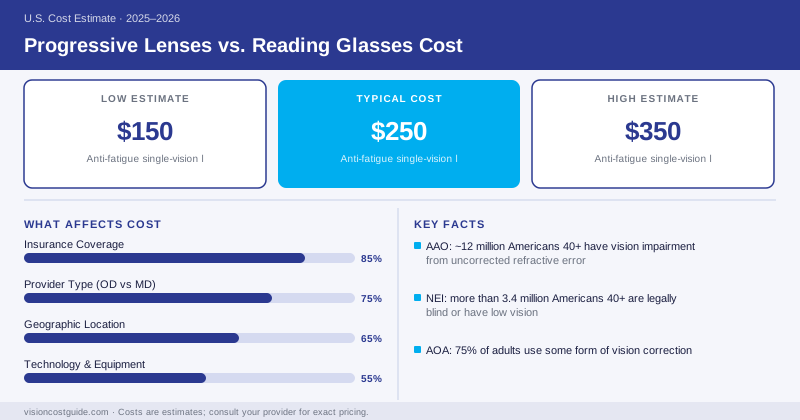
| Anti-fatigue single-vision lenses | $150–$350 | Long daily reading sessions; slight add at bottom |
The jump from $15 OTC to $100–$250 custom readers is worth it when you’re logging serious hours at a screen or with books. Custom readers use your exact prescription and monocular pupillary distance, so the optical centers sit where your eyes actually look. Headaches and eye strain from hours of reading often disappear when people switch from OTC to custom readers.
Progressive Lenses: The Full Cost Breakdown
Progressives are a single lens that handles distance, intermediate (arm’s length — computer, dashboard), and near vision in one. No switching glasses. No visible bifocal line. The trade-off: cost, an adaptation period, and peripheral distortion that improves with lens quality.
| Progressive Tier | Cost (both lenses + basic frame) | What You Get |
|---|---|---|
| Entry-level progressives (basic corridor) | $200–$400 | Narrow reading zone; adaptation can take 2–4 weeks |
| Mid-range digital progressives | $400–$700 | Wider corridor; better intermediate zone |
| Premium progressives (Varilux X, Zeiss Individual) | $700–$1,200 | Widest usable zones; least peripheral distortion |
| Digital progressives with anti-reflective coating | Add $100–$200 | Reduces glare; recommended for screen use |
| Prescription sunglasses (progressive) | $300–$700 | Separate pair; often necessary for outdoor use |
The difference between a $250 entry progressive and a $900 premium progressive is real but not linear. Entry progressives have narrower reading and intermediate corridors — meaning you need to move your head more to find the sweet spot, and peripheral swim is more pronounced. Premium progressives from Varilux, Zeiss, or Shamir are designed with larger, better-positioned corridors and often customized to your frame measurements and monocular PDs. They’re genuinely easier to adapt to. They’re also where optical practices make most of their margin — so the sticker price includes significant markup. Online progressive options (Zenni, EyeBuyDirect, Warby) can cut that cost to $100–$300 for a digital progressive, though you need an accurate PD measurement and a frame that fits properly.
Most people adapt to entry-level progressives in 1–4 weeks with consistent wear. A few don’t adapt at all and find single-vision readers more practical. Strategies that improve adaptation:
- Wear the progressives all day from day one — partial wear slows adaptation significantly
- Point your nose at what you want to see, rather than glancing with your eyes into the periphery
- Ask your optician about free-form digital progressives if you fail standard progressives — the wider corridors make a real difference for some patients
- If you’re still uncomfortable after 4–6 weeks, go back to your optician — the lens may need to be remeasured or the frame adjusted
The Break-Even Calculation
This is the actual question: does the cost of progressives pay off compared to having separate pairs?
Consider the typical presbyope who needs both distance glasses and readers. Full-price at an optical shop:
- Distance glasses: $200–$400
- Custom readers: $150–$300
- Total: $350–$700 for two pairs
Entry-level progressives: $250–$450. One pair. No switching.
At those numbers, progressives are competitive even at the entry tier — and the convenience value is significant if you’re switching glasses frequently throughout the day.
The break-even calculation shifts if you work at a computer for 8 hours. Computer screens sit at intermediate distance — roughly 20–26 inches — which falls in the middle corridor of a progressive. Many people find that intermediate zone cramped enough to cause neck strain (they tip their head back to find the sweet spot). A dedicated pair of computer glasses or occupational progressives (optimized for intermediate/near rather than distance/near) may be worth adding alongside your regular progressives for all-day desk work. Cost: $200–$400.
Before you commit to progressives, verify your prescription is current — ideally within the last 12 months. Progressives made to an outdated prescription won’t be comfortable regardless of lens quality. If your prescription has changed significantly, adaptation problems people attribute to “progressives not working” are often actually an outdated or inaccurate prescription. An exam co-pay ($50–$120 with vision insurance) before you spend $600 on lenses is money well spent.
Using Vision Insurance for Either Option
Most vision plans (VSP, EyeMed, Spectera) include an annual allowance covering:
- One pair of frames or contacts
- Single-vision, bifocal, or progressive lenses
- Basic lens add-ons (scratch coating, often UV)
Progressives are covered — but expect to pay an upgrade copay of $50–$150 even with in-network coverage, more for premium designs. OTC readers are never covered by vision insurance. Custom single-vision readers made with your prescription are typically covered as your annual lens benefit.
If you have both distance and near vision needs and your plan covers one pair of prescription lenses, progressives are usually the better value of your benefit — one pair instead of two, and the plan picks up the base cost.
The Practical Verdict
Reading glasses at $15–$50 are the right call if your distance vision is fine and you only need help for close work occasionally. Custom single-vision readers at $100–$250 are better if you’re logging hours at a screen or book daily.
Progressives make sense when you’re switching glasses more than two or three times a day — or when you need vision correction at multiple distances and you want the convenience of a single pair. The entry tier at $250–$400 is serviceable. If you’ve tried entry progressives and struggled to adapt, mid-range or premium digital progressives at $400–$700 have meaningfully better optics and are worth the upgrade before concluding that progressives “don’t work for you.”
Most people in their late 40s and early 50s who try progressives don’t go back to juggling two pairs.
Frequently Asked Questions
They won't damage your eyes, but they have real limitations. OTC readers assume both eyes need the same add power and that the optical center is positioned at a standard location. Most people have slightly different prescriptions in each eye and unique pupillary distances. The result is that OTC readers often cause headaches or eye strain with extended use — especially over 45 minutes of continuous near work. For occasional use they're fine; for people who read for hours daily, custom single-vision readers or progressives perform better.
Yes. Progressive lenses require a full refraction exam including your distance prescription, near add power, and pupillary distance (both monocular PD for each eye). OTC progressives exist — some online retailers sell them — but without your exact monocular PD the optical centers won't align with your pupils, and the narrow reading channel in a progressive becomes misaligned, causing distortion and eye strain. Always get progressives made to your specific prescription.
Progressive lenses are ground with a continuously changing power from distance at the top to near at the bottom, with a corridor in between for intermediate vision. That complex geometry requires precise digital surfacing and, for premium designs, customization to your specific pupillary measurements and frame dimensions. The technology, materials, and lab work involved are genuinely more complex than single-vision lenses — the markup on progressives is higher too, but so is the underlying cost to produce them.