The quote sitting in front of you says $4,800. For a prosthetic eye. You just had enucleation surgery, you’re still processing everything emotionally, and now you’re staring at a five-figure bill that insurance may or may not cover. Here’s what that number actually means — and whether it’s fair.
The American Academy of Ophthalmology (AAO) estimates that roughly 10,000 eye removal surgeries are performed in the United States each year, most due to trauma, retinal detachment complications, infection, tumors, or end-stage glaucoma. Every one of those patients eventually needs an ocular prosthesis. And most of them have no idea what the process costs, how it works, or what their insurance will actually pay.
This guide covers all of it.
Custom vs. Stock: The Core Decision
There are two categories of prosthetic eyes, and they’re not even close in terms of quality, comfort, or price.
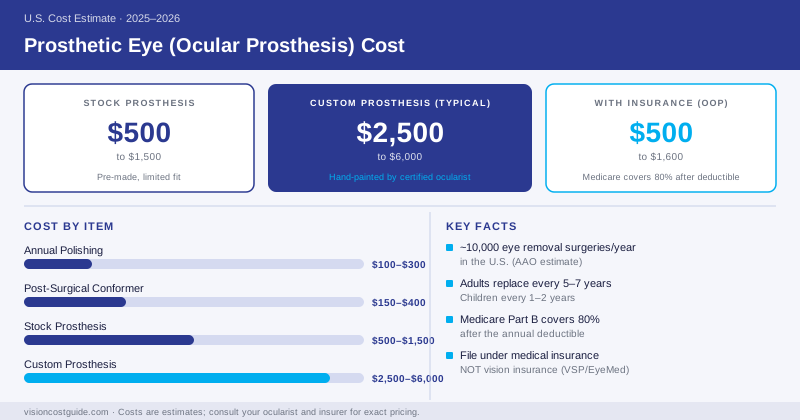
Custom acrylic prosthesis — This is what most patients end up with. A certified ocularist takes an impression of your eye socket, fabricates a custom-shaped acrylic shell, then hand-paints the iris, pupil, and blood vessel detail to match your natural eye. The result looks remarkably natural. Cost: $2,500–$6,000.
Stock prosthesis — Pre-made shells in standard sizes and a limited range of iris colors. No custom fitting, no custom painting. They’re cheaper — $500–$1,500 — but the fit is rarely ideal, they’re less comfortable for long-term wear, and the cosmetic match is obvious to most observers at close range. Stock prostheses are sometimes used as a temporary measure immediately after surgery while the socket heals.
For the vast majority of patients, the custom prosthesis is the right long-term choice. The comfort difference over years of daily wear is significant. Most insurers that cover prostheses at all will cover the custom option as medically necessary.
Full Cost Breakdown
| Item | Cost | Notes |
|---|---|---|
| Custom acrylic ocular prosthesis | $2,500–$6,000 | Fabricated and painted by certified ocularist |
| Stock (pre-made) prosthesis | $500–$1,500 | Limited color/size options; often temporary |
| Conformer (post-surgical placeholder) | $150–$400 | Used during socket healing, 6–8 weeks post-op |
| Annual polishing & maintenance | $100–$300/year | Recommended every 6–12 months |
| Prosthesis replacement (adult) | $2,500–$6,000 | Every 5–7 years as socket changes shape |
| Prosthesis replacement (child) | $2,500–$5,000 | Every 1–2 years during facial development |
| Insurance out-of-pocket (with Medicare/major medical) | $500–$1,600 | After deductible; varies by plan |
The Fitting Process: What Actually Happens
You won’t walk out of the hospital with a prosthetic eye. The socket needs time to heal first — typically 6–8 weeks. During that window, your surgeon places a conformer: a clear acrylic shell that maintains the socket shape while tissue heals. It’s not cosmetically matched; it’s a placeholder.
Once you’re cleared, you’re referred to an ocularist — a specialist certified by the National Examining Board of Ocularists (NEBO). Ocularists aren’t physicians; they’re precision craftspeople licensed specifically to fabricate and fit ocular prostheses. The fitting process typically involves:
- Impression — The ocularist takes a wax or alginate impression of your socket to get the exact shape. This takes 30–60 minutes and involves nothing more uncomfortable than keeping your eye closed while soft material sets.
- Fabrication — The custom shell is cast in acrylic, shaped, and polished. Takes 1–3 days in most cases.
- Painting — This is the art. A skilled ocularist hand-paints the iris pattern, pupil size, limbal ring, and fine blood vessel detail to match your other eye under magnification. A truly skilled painter can produce a result that most people won’t notice in normal conversation.
- Fitting appointment — You try the prosthesis, the ocularist adjusts the shape and edges for comfort and movement, and you get instructions for insertion, removal, and care.
- Follow-up — Most ocularists schedule a check-up at 4–6 weeks, then annually.
The National Examining Board of Ocularists (NEBO) maintains a directory of board-certified ocularists at nebo.org. Certification requires passing written and practical exams and completing a supervised apprenticeship — typically 5 years. When evaluating ocularists, ask to see a portfolio of their work. The quality of the painting varies meaningfully between practitioners. Your surgeon’s referral is a starting point, not the final word — it’s worth consulting two ocularists if you have geographic options.
Insurance Coverage in Detail
Ocular prostheses are covered by most major medical insurance plans as durable medical equipment (DME) or prosthetic devices — but coverage rules vary significantly.
Medicare Part B covers 80% of the Medicare-approved amount for ocular prostheses after you meet your deductible ($257 in 2026). You’re responsible for the remaining 20%. On a $4,000 custom prosthesis, that means roughly $800 out-of-pocket after the deductible — though the approved amount may be lower than the charged amount, so actual exposure varies. Medicare also covers medically necessary polishing and maintenance visits.
Commercial insurance coverage depends on your plan. Most plans classify ocular prostheses under the medical benefit (not vision benefit) as a prosthetic device. Check your plan’s Summary of Benefits under “prosthetics and orthotics.” Required documentation typically includes:
- Operative report from the enucleation or evisceration surgery
- Physician referral or prescription for an ocular prosthesis
- Prior authorization (required by many plans)
- Documentation of medical necessity (disease, trauma, or congenital absence — not cosmetic)
Medicaid coverage varies by state but generally covers ocular prostheses as medically necessary items for qualifying beneficiaries.
No insurance? The 60% of the prosthesis cost that Medicare doesn’t cover — or the full amount without any insurance — can be negotiated directly with the ocularist. Many will work on payment plans. The National Disability Rights Network and state vocational rehabilitation programs sometimes cover prostheses for working-age adults with qualifying diagnoses.
Don’t assume your vision insurance covers a prosthetic eye — it almost certainly doesn’t. Vision plans (VSP, EyeMed, Davis Vision) cover routine eye exams, glasses, and contacts. Ocular prostheses are medical devices and fall under major medical insurance. File your claim with your health insurance, not your vision plan. Using the wrong benefit and getting denied doesn’t mean you don’t have coverage — it means you filed with the wrong carrier.
Living With a Prosthetic Eye
Modern acrylic prostheses are significantly more comfortable than the glass eyes of prior generations. Most patients wear them all day and remove them for cleaning at night. Here’s what daily life actually looks like:
Insertion and removal — Your ocularist will teach you both techniques before you leave the fitting appointment. It takes most patients a week or two to feel fully comfortable. A small suction cup tool (included with the prosthesis) makes removal easier.
Cleaning — Daily cleaning with a saline solution and weekly cleaning with mild dish soap. Never use alcohol-based cleaners; they degrade the acrylic polish.
Wearing schedule — Most patients wear their prosthesis during all waking hours. Sleeping with it in is generally fine and often more comfortable than removal.
Movement — A well-fitted custom prosthesis moves with the eye muscles attached to the orbital implant placed during surgery. Movement won’t be identical to the natural eye, but a skilled fit produces natural-looking tracking that most observers don’t notice.
Sports and activities — Protective eyewear is strongly recommended for any contact sports or activities with projectile risk. The prosthesis itself is durable, but protecting your remaining natural eye becomes critically important once you’ve lost vision in one eye. The AAO’s guidelines on monocular vision and protective eyewear are worth reviewing with your ophthalmologist.
Maintenance Costs Over Time
This isn’t a one-time purchase. Factor in the long-term cost:
Annual polishing ($100–$300) is recommended every 6–12 months to remove protein deposits and restore surface smoothness that improves comfort. You’ll notice increased discharge and discomfort when polishing is overdue.
Adult replacement every 5–7 years is the typical cycle as the orbital socket changes shape and the prosthesis no longer fits as precisely. The total 10-year cost of a custom prosthesis — initial fabrication plus two polishing visits per year plus one replacement — runs roughly $6,000–$15,000.
For children, the cost is higher in the first decade because replacement happens every 1–2 years during facial development. A child who loses an eye at age 3 may need 6–8 prostheses before adulthood.
Research from the National Eye Institute (NEI) confirms that a well-fitted ocular prosthesis significantly reduces the psychosocial impact of eye loss. Studies show that patients who receive prompt fitting and skilled prosthetic care report better social functioning and self-image outcomes than those who delay or use poorly fitting devices. Getting a quality prosthesis from a skilled ocularist isn’t vanity — it’s a clinically meaningful part of recovery.
What to Ask Your Ocularist Before You Commit
Before signing any agreement, ask these questions:
- Are you board-certified by the National Examining Board of Ocularists (NEBO)?
- Can I see examples of your custom prosthesis work for patients with similar eye color to mine?
- Do you handle insurance billing directly, or do I need to file myself?
- What’s your policy if the fit needs adjustment in the first 30 days?
- How many follow-up visits are included in the fabrication fee?
A quality ocularist will answer all of these without hesitation. If you get vague answers or pressure to decide quickly, take your referral elsewhere.
The $4,800 quote at the top of this article? For a custom prosthesis from a certified ocularist in a major metro area, that’s squarely in the normal range. With Medicare or major medical insurance, your out-of-pocket on that number is likely under $1,500. Without insurance, ask about a payment plan — most practices accommodate them.
Frequently Asked Questions
A custom-fitted ocular prosthesis costs $2,500–$8,000 depending on whether it's a custom acrylic shell or a stock prosthesis. Custom prostheses, which are individually painted and fitted by an ocularist, cost $2,500–$6,000. Stock prostheses run $500–$1,500 but don't match the eye as closely. Polishing and maintenance runs $100–$300/year.
Most major medical insurance plans cover medically necessary ocular prostheses after enucleation or evisceration surgery. Medicare Part B covers 80% of the approved amount after the deductible — typically leaving patients with $500–$1,600 out-of-pocket. Coverage may require prior authorization and documentation that the eye loss was due to disease, injury, or congenital absence.
Adults typically replace their prosthetic eye every 5–7 years as the eye socket changes shape over time. Children need replacement more frequently — every 1–2 years — because facial anatomy changes rapidly during development. Annual polishing ($100–$300) by a certified ocularist is recommended to maintain appearance and comfort.