“Just grab some readers from the drugstore” is the most common advice given to people over 40 who notice they’re holding their phones farther and farther away. It’s not wrong — but it’s not the whole story.
Reading glasses and progressive lenses solve the same problem (presbyopia) in completely different ways. Picking the wrong one means either overspending on progressives you don’t need, or squinting through drugstore readers that don’t fit your actual prescription. Here’s how the costs actually break down.
The Presbyopia Problem, Briefly
Nearly everyone develops presbyopia between ages 40–50. The natural lens stiffens and loses its ability to flex for near focus. According to the American Academy of Ophthalmology, presbyopia affects an estimated 128 million Americans — essentially everyone who lives long enough.
Reading glasses compensate by adding magnification power (+1.00 to +3.50 diopters). Progressive lenses add the same near power at the bottom of the lens while maintaining your distance prescription across the top. If you don’t have a distance prescription that needs correcting, reading glasses are a completely reasonable solution. If you do — or if your near and far prescriptions differ between eyes — progressives or bifocals make more sense.
Reading Glasses: The Real Cost Range
| Reading Glass Type | Cost | Pros | Cons |
|---|---|---|---|
| Drugstore readers (OTC) | $10–$30 each | Instant, no prescription | Same power both eyes, no astigmatism correction |
| Online prescription readers | $30–$150/pair | Exact Rx, low cost | Need up-to-date prescription |
| Optical readers (in-person) | $100–$350/pair | Exact Rx, AR coating options | More expensive, slower |
| Computer glasses (specific distance) | $75–$250/pair | Optimized for screen distance | Not for general use |
Drugstore readers work if: Your reading add power is straightforward (+1.25 to +2.50 is the sweet spot), you don’t have significant astigmatism, and both eyes need similar correction.
Drugstore readers don’t work well if: You have significant astigmatism (common), your two eyes need different add powers, or you need them for extended computer use rather than brief reading sessions.
The often-missed issue with drugstore readers: they’re made with both lenses at identical power. Your left and right eyes may need different prescriptions. If your right eye is +2.00 and your left is +1.25, you’ll never be quite comfortable in any standard OTC reader. The solution isn’t to spend more — it’s to get an eye exam ($100–$250) and order prescription readers online from retailers like Zenni, EyeBuyDirect, or Clearly.
Online Prescription Readers: The Sweet Spot for Most
Prescription reading glasses from online retailers cost $30–$80 for complete pairs (lenses + frames). That’s prescription lenses, not OTC. Your optometrist’s exam gives you the reading add power; input it into the retailer’s system and you get your exact correction in 7–10 days.
Anti-reflective coating adds $15–$30 and is worth it for anyone using screens. Thin lenses for higher prescriptions add $20–$50.
A complete set — exam plus two pairs of prescription readers (one at home, one at work) — runs $250–$450. That’s cheaper than most single pairs of progressives.
Progressive Lenses: When They’re Worth It
Progressives make sense when:
- You have a distance prescription AND a near prescription — wearing reading glasses over contact lenses or switching between multiple pairs frustrates you
- You spend significant time at computer distance (middle range) — progressives cover near, intermediate, and distance in one lens
- You want one pair for everything — driving, computer, reading — without carrying multiple pairs
- You’re starting from an established frame and adding progressive lenses
Reading glasses and bifocals only address two distances: far (no correction, or your distance Rx) and near (reading add). But “computer distance” — about 20–24 inches from your face — is neither. It’s the intermediate zone. Standard reading glasses optimized for 12–16 inches are often too strong for comfortable computer use, causing eyestrain. Progressives cover this range naturally. If you’re spending 6+ hours/day at a computer, progressives or occupational lenses (near/intermediate only) may genuinely be worth their higher cost.
Progressive Lens Costs in Detail
| Progressive Type | Lens Only | Complete Pair | Notes |
|---|---|---|---|
| Basic progressive (conventional surfaced) | $150–$300 | $250–$500 | Narrower corridor, more distortion |
| Mid-tier progressive (digital) | $250–$450 | $400–$700 | Wider corridor, less distortion |
| Premium progressive (free-form digital) | $400–$700 | $600–$1,000+ | Best peripheral clarity, frame-customized |
| Occupational progressive (near/mid only) | $250–$450 | $400–$650 | Not for driving; office-optimized |
The total pair cost depends heavily on frame selection. Bring your own frames (rimless adjustment is possible but not always recommended) or choose budget frames to keep the total manageable.
The Adaptation Reality
Reading glasses: zero adaptation required. Put them on, see clearly at near, done.
Progressives: 1–2 week adaptation for most wearers; some take 4–6 weeks. During adaptation, peripheral swim and the need to move your head (not just your eyes) to find the correct zone are normal. About 10–15% of wearers don’t adapt successfully — though poor fitting measurements cause many of these failures, not the lens design itself.
If you’ve never worn progressives and you’re price-sensitive, starting with a mid-priced pair ($400–$600 complete) before committing to premium ($800+) makes practical sense. Adaptation tells you more than any in-office demonstration.
The Insurance Angle
Vision insurance (VSP, EyeMed, Spectera, etc.) typically provides an allowance for one complete pair per benefit period. The allowance for lenses is usually $60–$120; the allowance for frames is $130–$200. Progressive upgrade fees — the premium above basic lens coverage — are often your out-of-pocket responsibility.
Reading glasses may or may not be covered depending on your plan — some plans cover one pair of eyeglasses total, others specify distance correction only.
Both reading glasses and progressive lenses qualify for FSA and HSA spending. If you’re in the fall months and have unspent FSA dollars with a use-it-or-lose-it deadline, buying prescription readers or upgrading to premium progressives with that money is one of the best uses of those funds.
Don’t skip the eye exam to save money on reading glasses. OTC readers have one power for both eyes and no astigmatism correction. If you have significant uncorrected astigmatism — which you won’t know without an exam — OTC readers will cause headaches and eyestrain regardless of power. A $100–$150 exam that results in prescription readers is a far better investment than cycling through six pairs of drugstore readers that never feel quite right.
Which Should You Choose?
Reading glasses (start here if): You have no distance prescription, your budget is under $200, you mainly need near correction for reading and basic device use, and you’re not bothered by switching pairs.
Progressives (choose these if): You have both distance and near correction needs, you spend significant time at computer distance, you want one pair for all situations, and you’re comfortable with $400–$800 total spend and a brief adaptation period.
Occupational progressives (consider if): You’re on a computer 6+ hours daily, standard progressives feel uncomfortable at arm’s length, and you can maintain separate distance glasses for driving.
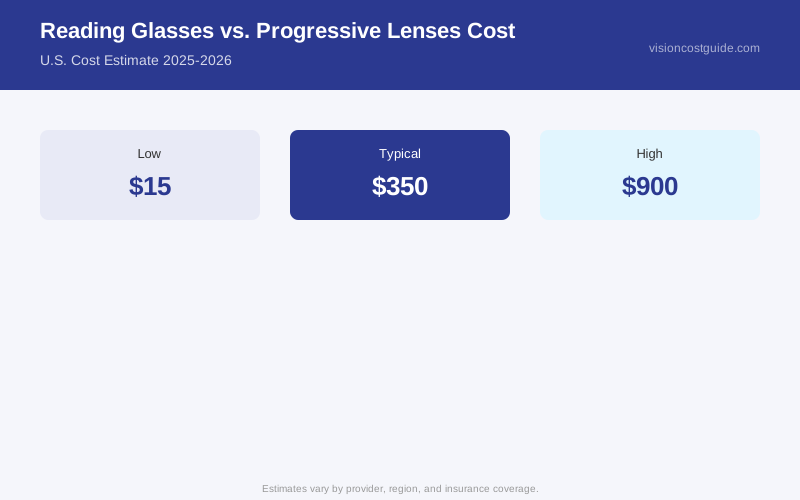
The reading glasses vs. progressives decision isn’t about which is “better” — it’s about which fits your vision correction needs and your actual daily life. Most people over 45 with a distance prescription end up at progressives eventually. But if you’re 42 with no distance Rx and just need help with your phone, a $15 pair from the drugstore or a $40 pair online is a completely legitimate choice.