4 things to know before you spend money treating recurrent corneal erosion — because most patients spend too much too fast, and some don’t spend enough in the right places.
1. The diagnosis is often missed. Recurrent corneal erosion (RCE) causes sudden, severe eye pain typically upon waking — the eyelid pulls away from the cornea and takes a piece of the epithelium with it. Patients describe it as “waking up feeling like something is in my eye” or stabbing eye pain that resolves over 30–60 minutes. Emergency rooms frequently diagnose it as “dry eye” or “corneal abrasion” and send patients home without addressing the underlying adhesion defect.
2. The first erosion is cheap. The pattern is expensive. A single erosion episode costs $150–$400 to treat (ER or urgent care visit, antibiotic drops, lubricating ointment). It’s the recurrence — weeks to years later — that drives the real cost.
3. Maintenance therapy is cheap; untreated recurrence is not. Consistent nightly lubricating ointment ($10–$15/month) significantly reduces recurrence risk. Patients who skip it face more ER visits, more episodes, and eventually need procedures.
4. Definitive procedures are far cheaper than years of recurring episodes. Anterior stromal puncture, PTK (phototherapeutic keratectomy), and alcohol epitheliectomy are one-time or low-frequency interventions costing $500–$3,000 that can break the erosion cycle permanently.
What Causes RCE and Why It Keeps Coming Back
The corneal epithelium (the surface cell layer) attaches to the basement membrane via hemidesmosomes — tiny anchor structures. After a corneal injury (typically a fingernail scratch, paper cut, or plant contact), or in people with anterior basement membrane dystrophy (ABMD/map-dot-fingerprint dystrophy), these anchors don’t reform properly. The epithelium heals but doesn’t bond securely — so it peels away again.
The National Eye Institute notes that corneal dystrophies, including ABMD, are among the most common corneal conditions — ABMD alone affects an estimated 2–4% of the general population, many without symptoms until an RCE event triggers the cycle.
Acute Episode Treatment Costs
| Setting | Cost | What Happens |
|---|---|---|
| Emergency room visit | $500–$2,500 | Exam, topical anesthetic, eye patch, Rx for drops |
| Urgent care center | $150–$400 | Similar to ER, less wait time |
| Optometrist/ophthalmologist urgent visit | $100–$300 | Best option if available |
| Topical antibiotic drops (prophylactic) | $15–$60 | Prevents secondary infection |
| Lubricating eye ointment (Muro 128 or Lacrilube) | $10–$20 | Reduces adhesion stress on healing epithelium |
| Bandage contact lens | $50–$150 | Protects epithelium during healing |
The most cost-efficient setting for an acute RCE episode is an urgent care optometry or ophthalmology clinic. If your eye doctor has an urgent slot, use it — the visit costs a fraction of ER pricing and the provider will actually recognize RCE vs. treating it as a generic abrasion.
Maintenance Phase: Preventing Recurrence
After the acute episode resolves (usually 2–5 days), the prevention phase determines whether this is a one-time event or a chronic problem.
Nightly lubricating ointment: $10–$20/month. Muro 128 5% (sodium chloride hypertonicity ointment) is specifically indicated for RCE because it dehydrates the surface slightly, improving epithelial adhesion over time. This is the most important cheap intervention. Use it nightly for 3–6 months minimum after an erosion.
Daytime preservative-free drops: $15–$30/month. Reduces friction during waking hours.
Total prevention cost: $25–$50/month. This is far less than one additional ER visit — and it works for many patients.
When Maintenance Fails: In-Office Procedures
If erosions recur despite consistent ointment use (3+ months), procedural intervention is appropriate.
Anterior Stromal Puncture (ASP): $300–$800
A needle or bent hypodermic creates tiny puncture marks in the anterior stroma (just below the epithelium). This provokes controlled scarring that anchors the epithelium more firmly. It’s done in-office, takes 15–20 minutes, and has a success rate of 70–80% for paracentral and peripheral erosions. Central erosions (in the visual axis) are avoided to prevent scarring that could affect vision.
Healing takes 1–2 weeks. One session is often sufficient; some patients need a second. Not typically covered by insurance as a standalone procedure, but your ophthalmologist may code it under a related diagnosis.
Diamond Burr Polishing: $400–$900
A rotating diamond-tipped burr removes loose epithelium and creates a fresh basement membrane surface. Success rates similar to ASP, particularly for cases involving ABMD where irregular basement membrane is the underlying issue. Done in-office with topical anesthesia.
PTK (Phototherapeutic Keratectomy): $1,500–$3,000/eye
PTK uses an excimer laser to ablate the surface epithelium and a precise, thin layer of anterior stroma, creating a smooth, uniform basement membrane surface. It’s the most definitive treatment for RCE associated with ABMD or recalcitrant cases.
Success rate: 75–90% at preventing further erosions. The procedure also treats ABMD directly, addressing the underlying cause rather than just the symptoms. It’s performed at laser eye surgery centers and takes 10–15 minutes per eye.
PTK is distinct from LASIK — it doesn’t correct refractive error (prescription). Your prescription will change slightly after PTK (usually becomes slightly more farsighted), which may require an updated glasses prescription.
Insurance note: PTK is sometimes covered by medical insurance (not vision insurance) when the diagnosis documentation is thorough. Prior authorization is typically required. Submit with the RCE diagnosis code plus documentation of multiple episodes and failed conservative management.
To maximize your chance of insurance coverage for PTK: 1) Document every erosion episode with dates, symptoms, and treatment; 2) Show 3+ months of consistent conservative treatment (ointment, drops) with continued episodes; 3) Get a letter of medical necessity from your ophthalmologist specifically documenting failed conservative management; 4) Submit a prior authorization before scheduling the procedure. The denial rate on initial submission is high, but successful appeals are common with thorough documentation. A corneal specialist (vs. general ophthalmologist) submission carries more weight with insurance reviewers.
Alcohol Delamination: $800–$1,500
Absolute alcohol applied to the corneal surface removes the epithelium and abnormal basement membrane together, allowing fresh, healthier regeneration. Used for diffuse ABMD cases. Success rates are similar to diamond burr polishing; often performed in a hospital outpatient setting, which affects billing.
Do NOT use contact lenses without an ophthalmologist’s guidance during active RCE treatment. Standard soft contact lenses can worsen the adhesion problem and introduce infection risk into an already-disrupted epithelium. Bandage contact lenses (prescribed specifically for corneal healing) are different — they’re therapeutically fitted and monitored. Self-managing RCE with daily contact lenses from your normal supply is not appropriate during active episodes.
Total Cost Scenarios
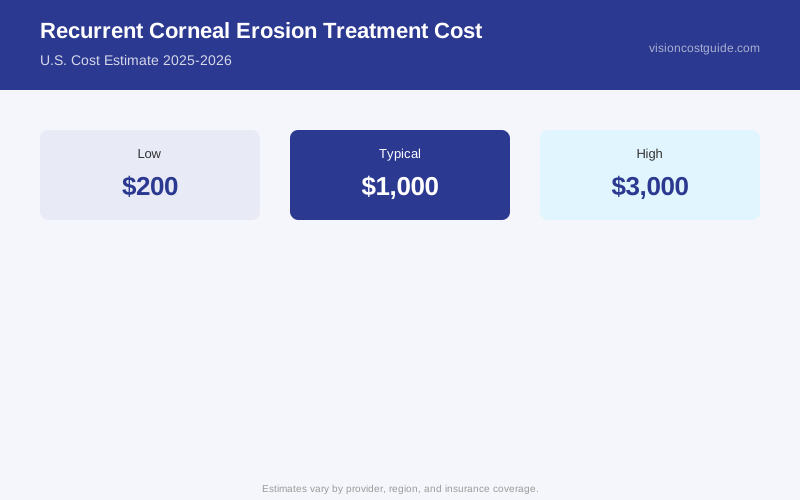
Single erosion, no recurrence: $200–$500 (one urgent visit + 3 months prevention supplies)
Mild recurrent case managed conservatively: $600–$1,500 over 1–2 years (multiple acute visits + ongoing prevention)
Moderate case requiring ASP or diamond burr: $1,000–$2,500 total including procedure and follow-up
Severe/refractory case requiring PTK: $2,000–$4,000 including procedure, pre-op workup, and follow-up; potentially partially covered by insurance
The pattern is clear: early, consistent prevention is dramatically cheaper than repeated acute episodes, and definitive procedures — while expensive upfront — are often cost-effective compared to years of recurring ER visits and lost workdays.