You noticed new floaters last Tuesday — maybe a flash of light in your peripheral vision. The next morning you were in your ophthalmologist’s chair with dilating drops, and now you’ve got a diagnosis: retinal tear. The doctor wants to do laser treatment today. You want to know what this costs.
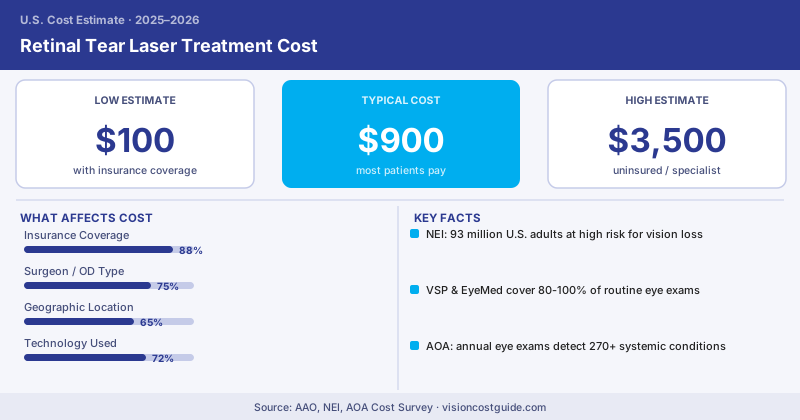
Here’s the answer: $500–$3,500 out-of-pocket without insurance. With Medicare or commercial coverage, most patients pay $100–$600. And here’s the bigger picture: treating a retinal tear now costs a fraction of what retinal detachment surgery runs ($10,000–$20,000+). This is one time you really don’t want to delay.
What Is Laser Treatment for a Retinal Tear?
The retina is the thin layer of tissue lining the back of your eye. When a tear forms — often from vitreous pulling on the retina as the gel in your eye shrinks with age — fluid can seep underneath and peel the retina away from the wall. That’s retinal detachment, and it’s a surgical emergency.
Laser photocoagulation (or sometimes cryotherapy, a freezing treatment) creates tiny burns or scars around the tear, sealing it before detachment occurs. The procedure takes about 10–20 minutes in the office and is done with dilating drops and a contact lens held on your eye. No incision, no OR, no general anesthesia.
The American Academy of Ophthalmology (AAO) notes that retinal tears are found in approximately 6% of the general population, with the rate rising significantly in people who are highly myopic (nearsighted), have had eye trauma, or have recently had a posterior vitreous detachment (PVD). The NEI estimates that roughly 15,000 Americans undergo retinal detachment surgery annually — many of whom had a preceding tear that could have been sealed.
Retinal Tear Laser Cost Breakdown
| Scenario | Typical Cost |
|---|---|
| In-office laser, self-pay | $500–$1,500 |
| In-office laser, Medicare with Medigap | $50–$150 |
| In-office laser, Medicare without Medigap | $100–$400 |
| In-office laser, commercial insurance | $100–$600 |
| ASC-based laser (self-pay) | $1,500–$3,500 |
| Cryotherapy (freezing) alternative | $500–$2,000 self-pay |
| Emergency department evaluation (if after hours) | $500–$2,000+ additional |
Does Insurance Cover Laser for a Retinal Tear?
Yes — consistently and reliably. A retinal tear with laser treatment is billed as a medically necessary procedure. CPT code 67145 (photocoagulation for retinal tear) or 67101 (cryotherapy) are recognized by Medicare and all major commercial insurers.
- Medicare Part B: Covers 80% after your deductible. Most retinal procedures are done in-office, so Part A (hospital) doesn’t apply.
- Commercial insurance: You’ll owe your copay or coinsurance. Because retinal tear treatment is medically necessary, it’s rare to see a prior authorization delay — though calling your insurer in advance to confirm is still smart.
- Vision-only plans: Vision plans (VSP, EyeMed) do NOT cover retinal laser. This is a medical procedure billed to your health insurance.
If you develop sudden floaters, flashes, or a dark shadow/curtain in your vision, call your ophthalmologist the same day — or go to an emergency eye care clinic. A symptomatic retinal tear (especially with new fluid underneath) can progress to full detachment within hours to days. Most retina specialists will see you urgently. Don’t wait for a routine appointment slot.
What Affects the Cost?
In-office vs. ASC: The biggest cost variable. Most retinal tear laser is performed in-office at a slit lamp — fast, effective, and less expensive. Some retina practices refer complex or posterior tears to an ASC setting, which adds facility fees.
Number of sessions: A small, well-defined tear usually requires one session. A large horseshoe-shaped tear or multiple tears may need additional treatment. Each session has its own fee.
Retina specialist vs. general ophthalmologist: Not all general ophthalmologists perform retinal laser. Retina specialists (fellowship-trained) charge more but are more experienced with complex tears. For straightforward tears, the extra cost may not be necessary; for large or posterior tears, see a retina specialist.
Urgency / after-hours: If you’re seen after regular office hours at an urgent eye care clinic or emergency setting, evaluation fees are higher. This is still the right move if you have acute symptoms.
After the Procedure: What to Expect
Laser for a retinal tear requires no downtime. You can go home immediately. A few things to know:
- Your vision may be blurry from the dilating drops for 4–6 hours.
- Some patients see the laser spots temporarily as dark dots in their vision — these typically fade.
- Floaters from your original PVD or tear often persist even after successful treatment. The laser seals the tear; it doesn’t remove floaters.
- You’ll need a follow-up exam in 3–6 weeks to confirm the seal is holding.
Even after successful laser treatment, you’re at increased risk for new tears in the same or fellow eye. Report any new floaters, flashes, or visual changes immediately — don’t assume everything is fine because you already had the tear sealed. Regular dilated eye exams become even more important after a retinal tear.
The $15,000 Reason to Treat Now
Retinal detachment surgery — vitrectomy or scleral buckle — costs $10,000–$20,000+ per eye and requires general or regional anesthesia, operating room time, and weeks of recovery. Vision outcomes are good when surgery is done promptly, but not everyone regains full central vision, especially if the detachment reached the macula.
Laser treatment for a retinal tear at $500–$1,500 is, without question, the better economic and clinical choice — as long as the tear hasn’t already progressed to detachment.
Bottom Line
Retinal tear laser is one of the highest-value procedures in all of eye care: quick, low-risk, and dramatically less expensive than the alternative. Insured patients typically pay $100–$600. Self-pay patients pay $500–$1,500 in most practices. Act fast — a 24–48 hour delay on a symptomatic tear can mean the difference between a 20-minute office procedure and a full surgery.