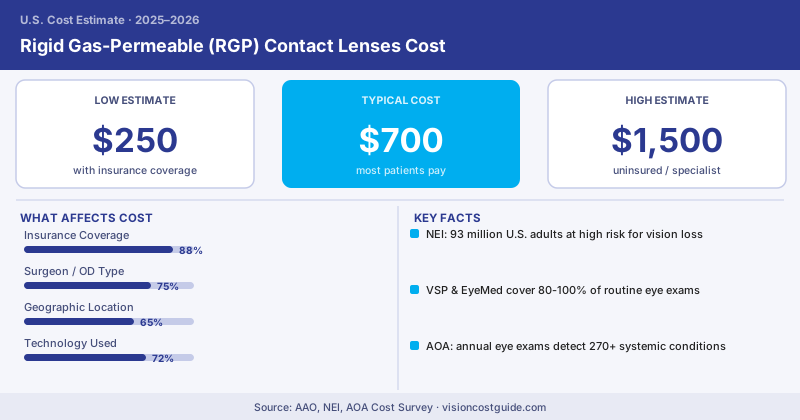
Most people assume RGP lenses are the old-fashioned option — something from the 1980s that nobody wears anymore. Wrong. Rigid gas-permeable contact lenses still outperform soft lenses for visual clarity in several common conditions, and they can actually cost less over a 2–3 year period once you factor in how long they last.
Here’s what they’ll run you: $100–$500 per lens, with a full fitting and startup cost of $500–$1,500 in year one. After that, annual costs drop to $300–$600 or less.
Who Actually Wears RGP Lenses?
RGP lenses aren’t for everyone, and they’re not trying to be. They’re the best option — sometimes the only practical option — for:
- Keratoconus and irregular corneas: Soft lenses conform to the irregular surface; RGPs vault over it and create a smooth optical surface with the tear layer.
- High astigmatism that’s difficult to correct with soft toric lenses.
- Post-surgical corneas (after LASIK, corneal transplant, or radial keratotomy) with induced irregularity.
- Patients who want the sharpest possible vision and are willing to tolerate an adaptation period.
The American Optometric Association (AOA) estimates that about 5–8% of contact lens wearers in the U.S. use rigid lenses of some type. That’s a minority share of the 45 million contact lens wearers nationally, but it’s a medically significant group — often patients who can’t see well with any other correction.
RGP Contact Lens Cost Breakdown
| Item | Typical Cost |
|---|---|
| RGP fitting exam (first-time) | $150–$400 |
| RGP lens cost (per lens) | $100–$500 |
| Pair of standard RGP lenses | $200–$800 |
| Specialty RGP (keratoconus, post-surgical) | $400–$1,500 per pair |
| RGP cleaning and conditioning solution (annual) | $80–$150 |
| Follow-up visits, year 1 | $100–$300 |
| Replacement pair (years 2–3) | $150–$500 |
| Annual total (ongoing, after year 1) | $250–$700 |
Contrast that with daily soft lenses, which can run $400–$1,000+ per year for a single pair of eyes. Over 3 years, RGPs often cost less — especially for specialty fits.
What Affects the Price?
Lens design complexity: Standard spherical RGPs for simple myopia are at the low end. Bitoric designs for high astigmatism, and specialty designs for keratoconus (like Rose K or McGuire lenses), command $250–$750 per lens.
Fitting complexity: An experienced optometrist fitting keratoconus patients may need multiple trial sets and fitting refinements before landing on the right parameters. Each refinement may incur an additional visit fee. First-year fitting fees for complex cases easily run $400–$800 before lenses are ordered.
Fitting philosophy: Some ODs include the first pair of lenses in the fitting fee; others charge separately. Ask before you schedule.
Geographic location: Like all professional services, fees in major metro areas (NYC, LA, Chicago) are higher than in smaller cities. An RGP fitting in rural Tennessee might run $150; the same in Manhattan might be $450.
Who’s doing the fitting: General optometrists can fit standard RGPs. Specialty contact lens practices or optometrists with cornea fellowship training charge more but often deliver better outcomes for complex cases.
Adaptation: The Real Cost People Don’t Talk About
RGP lenses have a real adaptation curve. For the first 1–4 weeks, many wearers find them uncomfortable — the hard edge of the lens is noticeable in a way soft lenses aren’t. About 20–30% of new RGP patients don’t complete the adaptation process.
This matters financially: if you spend $600 on an RGP fitting and lenses and then give up after 2 weeks, you’ve lost that money. Before committing, ask your optometrist:
- Am I a good candidate? (Some patients adapt easily; others never fully do.)
- Can I do a trial wear period before committing to the final lens order?
- What’s the return/remake policy?
Many specialty contact lens practices offer a 30–60 day trial period with RGPs. If the lenses aren’t working for you clinically or you can’t tolerate them, they’ll modify or remake the lenses at reduced or no additional charge. Always ask about the remake guarantee before ordering. A good fitting agreement protects your investment.
Does Insurance Cover RGP Lenses?
Partially, in some cases. Here’s how it breaks down:
- Vision plans (VSP, EyeMed, Spectera): Standard contact lens allowances ($150–$200/year) can be applied toward RGPs. Some plans have a specialty contact lens benefit for medically necessary lenses (keratoconus, post-surgical).
- Medical insurance: If you need RGP lenses for a medical condition like keratoconus, you may be able to bill the fitting and lenses to your medical plan rather than your vision plan. This requires appropriate ICD-10 diagnosis codes and documentation. Not all medical insurers cover contact lenses, but many do cover specialty contact lens fitting for irregular corneas.
- FSA/HSA: You can use FSA or HSA funds for RGP lenses and solutions — a tax-advantaged way to pay.
According to the NEI, keratoconus affects approximately 1 in 2,000 Americans. For these patients, RGP lenses or scleral lenses are often the only means of achieving functional vision — making the medical necessity case straightforward.
Never share, swap, or use another person’s RGP lenses. Unlike some soft lens emergencies where a similar-power spare might work temporarily, RGPs are individually fitted with precise curves matching your corneal shape. Using the wrong lens can cause corneal abrasions, warping, or infections. Always carry your spare pair and lens case when traveling.
Long-Term Cost Comparison
Assuming average costs and a 3-year lifespan:
RGPs, year 1 (fitting + lenses + solutions): ~$900–$1,200
RGPs, years 2–3 (replacement pair + solutions): ~$400–$700/year
3-year RGP total: ~$1,700–$2,600
Daily soft lenses, 3 years: ~$1,200–$3,000 (varies widely by brand)
Monthly soft lenses + solutions, 3 years: ~$900–$1,500
For straightforward prescriptions, the costs are roughly comparable. For patients with keratoconus or high astigmatism where custom soft lenses are $600+/year, RGPs often win on economics decisively.
Bottom Line
RGP lenses cost $200–$800 for a standard pair with fitting in the $150–$400 range. Specialty designs for keratoconus or post-surgical corneas can run $400–$1,500 per pair. After the higher year-one investment, ongoing costs are modest. They last longer, provide sharper vision for many prescriptions, and are the clinical gold standard for irregular corneas. If your optometrist has recommended them, the cost is almost always justified.