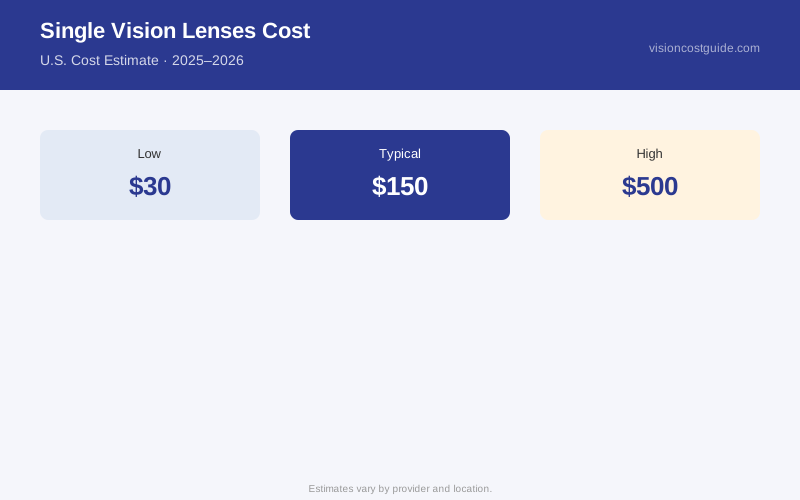
$30. That’s what single vision lenses cost online. Walk into a full-service optical shop and quote the same prescription, and you’ll hear $120–$300 for the same basic lens. Neither price is wrong — they’re just different channels with different service bundles. Here’s exactly what you’re buying at each price point and where the real differences lie.
What “Single Vision” Actually Means
Single vision lenses correct vision at one focal distance — either distance (for driving, TV) or near (for reading). They’re the most common lens type prescribed worldwide, covering people with myopia, hyperopia, and astigmatism who don’t yet need bifocals or progressives.
The American Optometric Association reports that 75% of Americans require some form of vision correction, and single vision lenses are the starting point for the vast majority. If you’re under 40 and have never needed reading glasses, single vision is almost certainly what you have.
Price by Purchase Channel
| Where You Buy | Lens-Only Cost | What’s Included |
|---|---|---|
| Online (Zenni, Clearly, Firmoo) | $6–$30 | Basic lens, basic AR sometimes |
| Online premium (Warby Parker, EyeBuyDirect) | $25–$95 | Better AR coating, UV protection |
| Wholesale club (Costco, Sam’s Club) | $60–$120 | Quality lab, professional fitting |
| Independent optician | $90–$200 | In-house lab or premium lab, full service |
| Ophthalmology practice / hospital optical | $120–$300 | Clinical-grade lab, full follow-up |
| Designer/luxury optical | $150–$400+ | Premium lenses, branded experience |
These are lens-only prices. Add $50–$300 for frames, and you get the full pair cost.
What Drives the Price Difference?
Lens material is the biggest variable. Standard CR-39 plastic — fine for moderate prescriptions — costs the least. Polycarbonate adds $20–$60 and is impact-resistant (required for children). Trivex adds $30–$80 and offers slightly better optics with similar impact resistance. High-index materials (1.67, 1.74) for strong prescriptions add $80–$200 over standard.
Coatings often cost as much as the lens itself:
- Anti-reflective coating: $30–$120 (basic to premium, like Crizal)
- Scratch-resistant hard coat: $15–$40 (often bundled)
- UV400 protection: $10–$30 (often bundled with AR)
- Blue light filter: $20–$80 (add-on or built into lens)
- Anti-fog treatment: $15–$40
Lab quality matters more than most buyers realize. A $30 lens made in a quality lab can outperform a $120 lens made in a budget one. The quality of the surfacing process — how precisely the lens is cut to your prescription — affects visual acuity and comfort.
Strong prescription (beyond ±4.00): High-index materials reduce thickness significantly. The visual and cosmetic improvement is real — this is where spending on lens material is justified.
Active lifestyle: Polycarbonate or Trivex for anyone who plays sports, works with tools, or has kids. Standard CR-39 shatters on impact; polycarbonate flexes. The $30–$60 upgrade is cheap safety.
Digital-heavy work: Premium AR coating pays back in visual comfort for anyone staring at screens 6+ hours daily. A quality AR coating (Crizal Sapphire, Zeiss DuraVision) reduces glare, improves contrast, and resists smudging noticeably better than budget AR.
First pair in a new prescription: Have your first pair professionally fitted — at least once — to confirm the prescription feels right before ordering online repeatedly.
The Online vs. In-Person Decision
Online single vision lenses are genuinely good for most straightforward prescriptions. The labs Zenni and similar retailers use produce optically accurate lenses. For a simple −2.50 sphere prescription with no special needs, a $20 online pair works just fine.
The case for in-person:
- Astigmatism corrections above −1.75 cylinder require precise axis alignment — small errors cause visual distortion
- High prescriptions (beyond ±5.00) need accurate PD measurement and proper frame fitting
- Children’s lenses need professional fitting for the best optical centering
- New prescriptions are worth verifying in person before reordering online repeatedly
A CDC survey found that adults with diagnosed vision problems who went without correction cited cost as the primary barrier. That’s where online retailers genuinely help — they’ve made functional, accurate single vision lenses accessible at a price that removes the access barrier.
Insurance Coverage for Single Vision Lenses
Most vision insurance plans (VSP, EyeMed, Humana) include single vision lens coverage with an annual or biannual benefit. Typical covered amounts:
- In-network: Lenses fully covered at standard options, $25–$80 copay
- Premium coatings (AR, photochromic): $20–$70 upgrade copay
- Frames: $130–$200 allowance toward frame cost
Check whether your plan covers “standard” or “premium” AR coating — the difference is meaningful for daily wearers.
Lens warranties vary dramatically. Some online retailers offer free replacement within 30 days for prescription errors; in-person opticians typically offer 60–90 day exchange periods. If you get a new prescription or your eyes change, verify the policy before ordering. A no-questions-asked remake guarantee is worth specifically asking about — it’s not universal.
What You Should Actually Pay
For a single adult with a moderate prescription (under ±4.00 sphere, under −1.50 cylinder):
- Budget-conscious: $30–$80 total online (complete pair including basic frames and AR)
- Quality online: $60–$150 at Warby Parker or similar
- In-person value: $150–$250 at Costco or an independent optician
- Premium in-person: $300–$500 with premium AR at a full-service optical
There’s no reason to spend $500 on single vision lenses with a standard prescription. If you’re being quoted above that range, ask what’s driving the cost — or get a second quote.