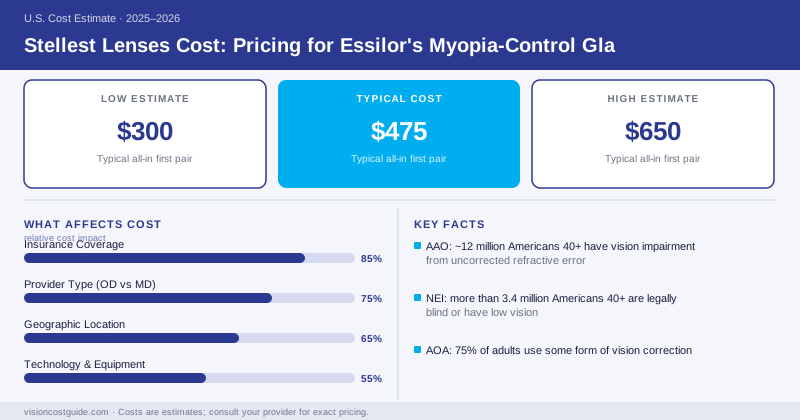
Most parents assume myopia glasses just correct blur. Stellest lenses do something more: they’re engineered to slow the eye from getting worse, and the price reflects that. Expect $250 to $500 for the lenses alone, or $300 to $650 once frames are in the picture.
Made by Essilor, Stellest uses a cluster of tiny lens segments arranged in rings around a clear central zone. Your child sees normally through the center while the rings create a signal that tells the eye to slow its growth.
How They Work
The technology is called H.A.L.T., short for Highly Aspherical Lenslet Target. Hundreds of microscopic lenslets sit on the lens surface, projecting a focal point in front of the retina. That defocus signal appears to discourage the elongation that drives nearsightedness.
It’s the same general principle behind other myopia-control spectacles, but Essilor’s clinical data is what put Stellest on the map. The company’s two-year trial, presented at major ophthalmology meetings, found a 67% average slowdown in myopia progression for kids who wore the lenses at least 12 hours daily. Wear time matters: kids who wore them less saw a smaller benefit.
What You’ll Pay
| Item | Cost Range |
|---|---|
| Stellest lenses (pair) | $250–$500 |
| Frames | $50–$200 |
| Fitting and measurement | Often included |
| Follow-up myopia visits | $80–$150 each |
| Typical all-in first pair | $300–$650 |
The lens price is the bulk of it. Frames are flexible, so you can keep total cost down with an entry-level frame or splurge if your child is hard on glasses. Either way, these run noticeably more than standard kids’ glasses, which typically land at $50 to $150 a pair.
Stellest lenses cost $250–$500 per pair, $300–$650 all in. The 67% slowdown in Essilor’s trial is among the strongest published for any spectacle lens, but it only holds if your kid wears them at least 12 hours a day.
The U.S. Availability Catch
Here’s the wrinkle. Stellest launched widely in Canada, Europe, and Asia before the United States. As of 2026, U.S. availability is still patchy, concentrated in dedicated myopia-management practices. Some families near the border have crossed into Canada to buy them.
If your optometrist doesn’t carry Stellest, ask about MiYOSMART or other myopia-control spectacle lenses, which work on a similar defocus principle. Our myopia control cost guide walks through the lineup.
Why Insurance Usually Says No
Like most myopia-control products, Stellest is typically treated as an elective upgrade rather than basic correction. Vision plans cover a standard single-vision lens but not the premium myopia-control version, leaving you to pay the difference out of pocket.
The good news is that FSA and HSA funds cover the gap. Keep your itemized receipt showing the lens type and medical purpose.
Stellest only slows progression while worn consistently. Part-time wear, like glasses-on-for-school but off-at-home, sharply reduces the benefit. If your child resists wearing glasses, a daily soft myopia-control contact lens or atropine drop may deliver better compliance.
Are They Worth It?
For a child who already wears glasses full time and tolerates them well, Stellest is one of the easiest myopia-control choices: no lenses to insert, no drops to remember, just glasses they’d be wearing anyway. The premium over standard lenses buys a documented slowdown in eye growth.
The math gets compelling over time. Slowing progression now means lower prescriptions and lower long-term risk of serious eye disease, which the National Eye Institute links to high myopia. That can offset the higher upfront price across a childhood of lens replacements.
Start with a pediatric eye exam to confirm your child is a candidate and get a measured prescription. Then ask your myopia-management optometrist whether Stellest, a competitor lens, or a combined approach fits your budget and your kid’s daily habits best.
Frequently Asked Questions
Stellest lenses alone run about $250 to $500 per pair, with the total reaching $300 to $650 once you add frames. Prices vary by region and whether your optometrist bundles fitting and follow-up.
Yes. Essilor's published trial reported that Stellest slowed myopia progression by an average of 67% versus single-vision lenses when worn at least 12 hours a day over two years.
Availability has been limited in the U.S. compared to Canada, Europe, and Asia. As of 2026, some U.S. myopia-management practices stock them, but you may pay out of pocket since insurance rarely covers myopia-control lenses.