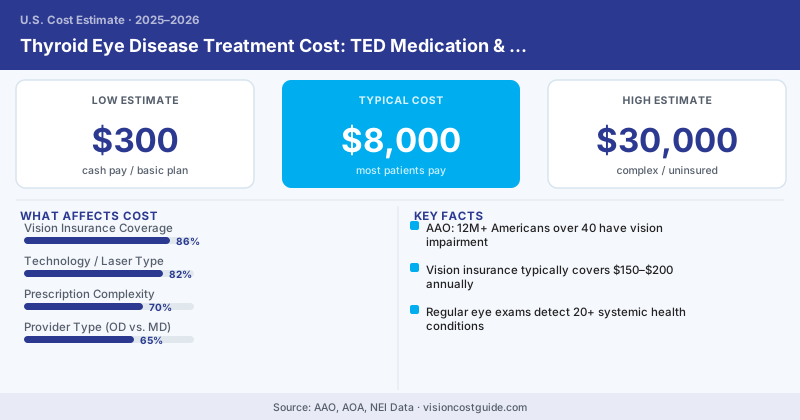
Sarah noticed her eyes looked different in photos — slightly more prominent, a little more staring. She thought she was imagining it. Six months later she had double vision and couldn’t close her right eye at night. Her endocrinologist confirmed thyroid eye disease (TED), and her ophthalmologist said she’d need treatment. The costs she was quoted ran from a few hundred dollars a year to over $25,000 depending on how aggressive the disease was.
That range isn’t a mistake. TED is one of the most expensive eye conditions to treat — and the costs depend enormously on which phase you’re in and how severe your disease is.
What Is Thyroid Eye Disease?
TED is an autoimmune condition most commonly associated with Graves’ disease (hyperthyroidism), though it can also occur in people with normal or low thyroid function. The immune system attacks tissue behind the eye, causing inflammation, swelling, proptosis (eye bulging), double vision, and corneal exposure.
The AAO estimates that TED affects roughly 25–50% of people with Graves’ disease at some level of severity, with 3–5% experiencing vision-threatening disease. There are two phases: an active inflammatory phase (months to a few years) and a stable, “burned-out” phase. Treatment strategies differ significantly between phases.
Cost Overview by Treatment Type
| Treatment | Cost Range |
|---|---|
| Selenium supplements (mild active disease) | $15–$40/month |
| Lubricating eye drops + prism glasses | $50–$300/year |
| IV methylprednisolone (steroid infusions) | $1,200–$3,500 per course |
| Tepezza (teprotumumab) infusion series | $15,000–$30,000+ out-of-pocket (before insurance) |
| Orbital decompression surgery | $8,000–$20,000 |
| Strabismus (eye muscle) surgery | $4,000–$10,000 |
| Eyelid retraction repair surgery | $2,500–$6,500 |
Mild Disease: Managing Without Major Costs
Many TED patients have mild, self-limiting disease that doesn’t require expensive intervention. For this group, treatment is mostly:
- Selenium 200 mcg/day: A 2011 European study showed selenium significantly reduced mild active TED progression. It’s cheap — $15–$40/month at any pharmacy — and the AAO now includes it in treatment guidelines for mild active TED.
- Lubricating drops and gels: Protect corneas during active inflammation. Cost: $15–$40 per bottle.
- Prism glasses: If mild double vision is present, prism lenses added to glasses can help. Expect $100–$300 for the lenses.
If you’re in this category, you might spend $200–$400 per year on TED-related costs, plus regular monitoring visits ($100–$250 each with insurance).
Moderate to Severe Active TED
When inflammation is significant — with painful proptosis, compressive optic neuropathy risk, or worsening double vision — treatment escalates.
IV glucocorticoids (steroids): Intravenous methylprednisolone given weekly for 12 weeks is the established first-line therapy for moderate-severe active TED. The drug itself is inexpensive; the infusion facility costs drive the price. Total course: $1,200–$3,500 depending on where it’s administered (hospital outpatient vs. infusion center vs. office).
Tepezza (teprotumumab): Approved by the FDA in 2020 specifically for TED, this is the first drug designed to treat the underlying mechanism. Eight infusions over about 5 months. The list price is approximately $14,900 per infusion — over $100,000 for a full course. With insurance, most commercially insured patients qualify for cost-sharing assistance programs that reduce their out-of-pocket to $0–$3,000 for the full series. Without insurance, it’s essentially unaffordable unless Horizon Therapeutics’ patient assistance program kicks in.
Tepezza is covered by most major commercial insurers and Medicare Part B for active, moderate-to-severe TED. Prior authorization is required, and your ophthalmologist will need documentation of clinical activity score, proptosis measurements, and symptom severity. If denied, appeals succeed in roughly 60–70% of cases with proper documentation. Horizon’s UPLIFT patient assistance program covers eligible uninsured and underinsured patients — visit tepezza.com or call 1-888-4TEPZZ to check eligibility.
Surgical Phase: After Active Disease Stabilizes
Most surgeons won’t operate on TED during the active phase because tissue changes could alter outcomes. Once the disease is stable for at least 3–6 months, surgical rehabilitation follows a sequence:
- Orbital decompression first — removes bone and/or fat behind the eye to reduce proptosis and relieve optic nerve compression. Cost: $8,000–$20,000 depending on approach and extent.
- Strabismus surgery second — corrects double vision caused by scarred or tethered eye muscles. Cost: $4,000–$10,000.
- Eyelid surgery last — repairs retracted lids. Cost: $2,500–$6,500 per procedure.
This surgical sequence often requires multiple procedures over 1–2 years. With insurance, each procedure triggers separate deductibles and copays — budget $2,000–$6,000 in total surgical cost-sharing across the sequence if you have decent commercial coverage.
Do not let your ophthalmologist talk you out of staging these surgeries in the correct order. Orbital decompression changes the position of the eye — which changes the strabismus — which changes lid position. Doing them out of order means potentially redoing earlier work. A few extra months of patience saves significant money and reduces total surgeries needed.
Monitoring Costs
During active TED, expect ophthalmology visits every 4–12 weeks. Each visit typically includes visual acuity testing, proptosis measurement with exophthalmometry, and possibly visual field testing. With commercial insurance and standard copays, budget $50–$150 per visit. Orbital MRI (to assess inflammation and optic nerve) runs $800–$2,500 with insurance depending on your plan.
Finding Specialists
TED requires a multidisciplinary team: endocrinologist (for thyroid control), ophthalmologist with TED experience, and oculoplastic surgeon for surgical cases. The North American Neuro-Ophthalmology Society (NANOS) and ASOPRS both maintain specialist directories. Controlling the underlying thyroid condition is the single most important step in limiting TED severity — uncontrolled thyroid disease makes TED worse and more expensive.