42% of Americans over 65 wear some form of multifocal lens correction, according to the American Academy of Ophthalmology’s epidemiology data. But most people in that group have never even heard of trifocals — they went straight from bifocals to progressives. That’s a shame, because for a specific type of patient, trifocals are genuinely better than either option.
What Trifocal Lenses Do
Trifocal lenses have three distinct optical zones: distance (top), intermediate (middle), and near (bottom). The intermediate zone — usually about 7mm wide — handles the arm’s-length distance: computer screens, dashboard instruments, grocery store shelves, sheet music.
Bifocals skip the intermediate zone entirely, leaving an optical gap around 20–24 inches. Progressive lenses cover the same range as trifocals but transition gradually rather than using hard lines. Trifocals sit in the middle: three clear zones with two visible lines.
What They Cost
| Lens Type | Lens-Only Cost | Complete Pair (with frames) |
|---|---|---|
| Standard trifocal (flat-top 28 or 35) | $75–$175 | $150–$350 |
| Executive/E-style trifocal | $100–$200 | $180–$400 |
| Polycarbonate trifocal | $110–$225 | $200–$425 |
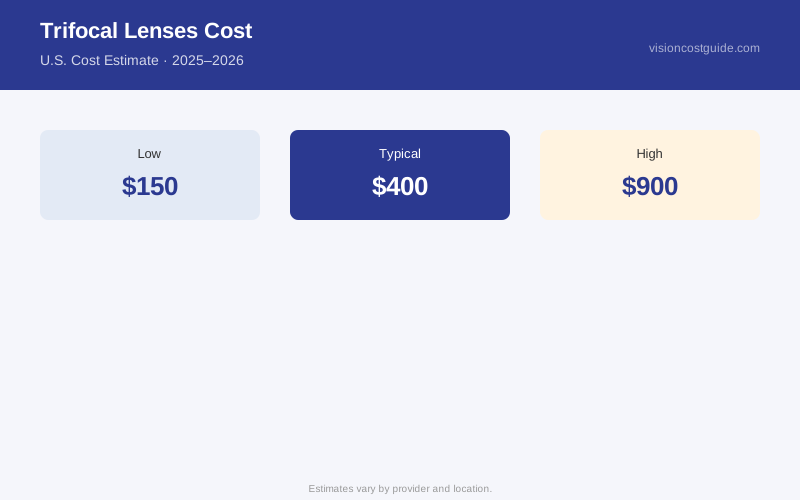
| High-index trifocal | $175–$350 | $280–$550 |
| Trifocal with premium AR coating | Add $50–$120 | — |
Trifocals are priced above bifocals (typically by $30–$80) but below progressives. For patients who adapt well to lined multifocals, they represent solid value — often $150–$300 less than premium progressives.
Who Should Consider Trifocals?
Trifocals make the most sense for patients who:
Tried progressives and couldn’t adapt. About 10–15% of first-time progressive wearers don’t fully adapt — the “swim” effect, narrow corridor, and need to precisely position the head remain disorienting. For these patients, trifocals provide clear correction at all three distances without the peripheral distortion.
Do significant intermediate-distance work. Bifocals leave the intermediate zone blurry. If you spend hours at a computer or doing close-to-mid work (like music reading, woodworking, or lab work), that gap is a real problem. Trifocals solve it cleanly.
Have strong add powers (+2.50 and above). At high add powers, trifocals maintain wider reading and intermediate zones than standard progressives. Some high-add patients report clearer near vision with trifocals than with even premium progressives.
Prefer a predictable, immediate adaptation. Progressives require the wearer to “find” the focal zone. Trifocals, like bifocals, are immediate — you learn exactly where to look and it stays there.
Flat-top trifocal (FT-28 or FT-35): The most common style. The near segment is a D-shaped or flat-top zone at the bottom, with a narrower intermediate strip above it. FT-35 has a wider near segment (35mm vs 28mm), which more patients prefer. Standard pricing: $75–$175 for lenses.
Executive or E-style trifocal: The intermediate and near segments run the full width of the lens — no visible D-segment, just two full-width lines dividing the lens into thirds. Preferred by patients doing extensive intermediate work (musicians, artists, lab technicians) who need the full width of all three zones. Usually $100–$200 for lenses; cosmetically more noticeable than flat-top.
Both are available in polycarbonate and high-index materials for strong prescriptions. The material upgrade ($40–$150) is worthwhile for prescriptions above ±4.00.
Trifocals vs. Progressives vs. Bifocals: Cost and Fit
| Bifocal | Trifocal | Progressive | |
|---|---|---|---|
| Visible line | Yes (1) | Yes (2) | No |
| Intermediate zone | None | 7mm strip | Gradual transition |
| Adaptation time | 1–2 days | 3–7 days | 2–6 weeks |
| Peripheral distortion | None | None | Moderate (standard) |
| Lens-only cost | $50–$150 | $75–$225 | $150–$650 |
| Best for | Distance + reading only | Distance + computer + reading | Active lifestyle, cosmetics |
The progression from bifocal to trifocal to progressive isn’t a natural upgrade path — it’s a clinical fit decision. A 72-year-old retired accountant who failed progressive adaptation twice and works at a computer four hours daily is a trifocal patient. A 55-year-old new presbyope who golfs three times a week and has never worn multifocals is a progressive patient.
Insurance and FSA/HSA Coverage
Trifocals are covered by most vision insurance plans the same way bifocals are — as standard lined multifocal lenses. Typical in-network coverage: lenses fully covered at standard tier, with a modest upgrade copay ($15–$40) for polycarbonate or premium materials.
FSA and HSA funds cover trifocals as a qualified medical expense.
Not all optical labs stock trifocal blanks — and not all opticians have experience fitting them. If your optician seems unfamiliar with trifocal fitting specifics (segment height, near segment style), ask whether they regularly dispense them or consider a second opinion. Poorly fitted trifocals with incorrect segment height are a common reason patients conclude they “don’t work” — when the real issue is the fitting, not the lens design.
The Bottom Line
Trifocal lenses run $75–$350 for the lenses themselves, or $150–$550 for a complete pair including frames. They cost more than bifocals and less than progressives. They’re not obsolete — they’re the right choice for patients who want clear intermediate correction without progressive distortion, or who’ve never adapted to lined multifocals. If your optician hasn’t mentioned them as an option and you’re struggling with progressives, ask directly.