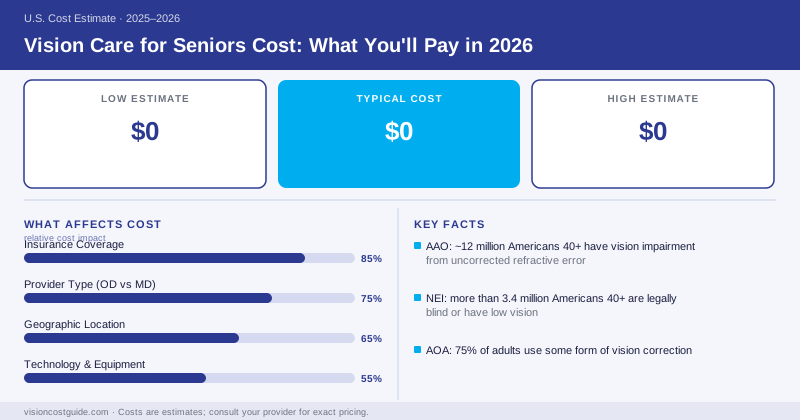
Half of all Americans will have a cataract by age 80, according to the National Eye Institute — and that’s just one of the conditions that makes vision care more involved, and more expensive, after 65. Annual costs for seniors range widely: $200 to $600 for routine care, climbing past $1,500 when an age-related condition needs treatment.
The biggest surprise for most retirees? What Medicare doesn’t pay for.
The Medicare gap
This trips up nearly everyone. Original Medicare (Parts A and B) does not cover routine eye exams or eyeglasses. It covers medical eye care — but not the everyday stuff.
| Service | Medicare Coverage | Typical Out-of-Pocket |
|---|---|---|
| Routine eye exam | Not covered | $50–$200 |
| Eyeglasses/contacts | Not covered* | $150–$600 |
| Cataract surgery | Covered (Part B) | 20% after deductible |
| Glaucoma test (high-risk) | Covered | 20% after deductible |
| Diabetic eye exam | Covered | 20% after deductible |
*Medicare covers one pair of basic glasses only after cataract surgery with an implanted lens.
Original Medicare won’t pay for routine exams or glasses, but it does cover cataract surgery, glaucoma screening for high-risk patients, and diabetic eye exams. Budget $200 to $600 a year for routine care out of pocket — or get a Medicare Advantage plan that bundles a vision benefit.
Why annual exams matter more after 65
The AOA recommends seniors get a comprehensive eye exam every year. The reason is blunt: glaucoma, macular degeneration, and early cataracts often cause no symptoms until damage is done. The NEI estimates that the number of Americans with age-related macular degeneration is projected to rise sharply as the population ages.
An annual exam catches these early, when treatment is cheapest and most effective. Skipping it to save $150 can cost thousands later.
The big-ticket conditions
Cataracts. The most common senior eye surgery. Medicare covers it, and you pay roughly 20% after your deductible — often $300 to $1,500 per eye out of pocket depending on lens choice.
Glaucoma. Drops and monitoring are ongoing. Medicare covers screening for high-risk seniors annually.
Macular degeneration. Injections for the “wet” form can run hundreds per dose, though Medicare covers medically necessary treatment.
Diabetic eye disease. If you have diabetes, Medicare covers a yearly dilated exam — and you should never skip it.
Don’t assume Medicare has your routine vision needs covered. Many seniors discover at the optical counter that glasses and routine exams are entirely out of pocket. Confirm your coverage before you book, and consider a Medicare Advantage plan or standalone vision plan if you wear glasses.
Glasses and progressives
Most seniors need progressive lenses to handle reading, the computer, and distance in one lens — figure $250 to $500 a pair. A simpler pair of single-vision eyeglasses runs $150 to $300. And since glare and night driving worsen with age, many seniors add anti-reflective coating, which our eye strain treatment guide explains.
How to manage the cost
- Compare Medicare Advantage vision benefits during open enrollment.
- Consider standalone vision insurance if you stay on Original Medicare.
- Use community resources — programs like EyeCare America offer free or low-cost exams for qualifying seniors.
- Ask about senior discounts at optical retailers; many offer 10% to 30% off frames.
- Don’t skip the annual exam — it’s the cheapest care you can buy.
Bottom line
Plan on $200 to $600 a year for routine senior vision care, knowing Original Medicare won’t cover exams or glasses. It will cover cataract surgery, glaucoma screening, and diabetic exams. Get the annual exam without fail, weigh a Medicare Advantage vision benefit, and you’ll catch the expensive conditions while they’re still cheap to treat.
Frequently Asked Questions
Routine annual costs run $200 to $600 for an exam and glasses. Add age-related conditions like cataracts or macular degeneration and total yearly costs can exceed $1,500 out of pocket.
Original Medicare does not cover routine eye exams or glasses. It does cover medical eye care — like cataract surgery, glaucoma testing for high-risk patients, and diabetic eye exams. Many Medicare Advantage plans add a vision benefit.
The American Optometric Association recommends adults 65 and older get a comprehensive eye exam every year, because conditions like glaucoma, cataracts, and macular degeneration become far more common with age and often show no early symptoms.