Most people with visual snow have seen dozens of doctors before getting a diagnosis. The optometrist says your eyes are fine. The neurologist says it’s migraines. The psychiatrist says it’s anxiety. Meanwhile the static, the after-images, the halos, and the light sensitivity don’t go away. If you’ve finally received a visual snow syndrome (VSS) diagnosis — or suspect you have it — here’s an honest breakdown of what evaluation and management actually cost.
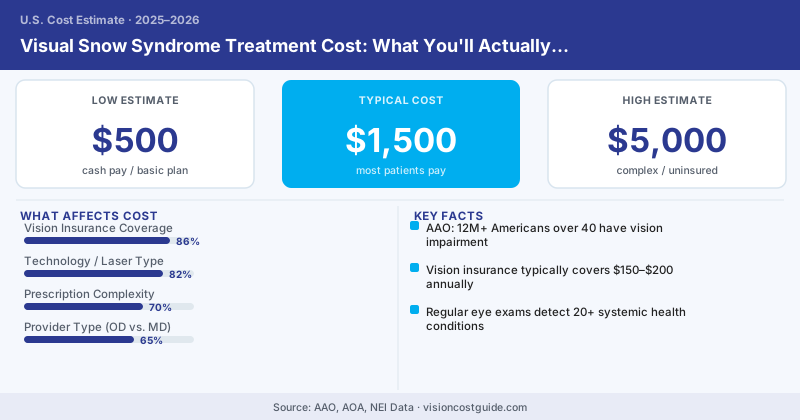
The short version: there’s no FDA-approved treatment, no surgical fix, and no pill that makes it disappear. But symptom management, specialist evaluation, and ruling out dangerous mimics will likely cost $500–$5,000 in the first year, with lower ongoing costs if you find an approach that helps.
What Is Visual Snow Syndrome?
Visual snow syndrome is a neurological condition characterized by persistent static or “snow” overlaid on vision in both eyes, often accompanied by after-images, visual trailing, floaters, light sensitivity, and night vision disturbance. It’s distinct from floaters and migraine aura.
A landmark 2020 study from University College London confirmed VSS as a distinct clinical entity affecting an estimated 2–3% of the general population to some degree. The AAO acknowledges VSS in its clinical guidelines but notes that ophthalmologic examination is typically normal — the disorder originates in the visual cortex, not the eye itself.
The Diagnostic Workup: What It Costs
Before anyone treats visual snow, the priority is ruling out other causes of visual disturbance — retinal disease, optic neuritis, migraine, or medication side effects.
| Service | Typical Cost |
|---|---|
| Comprehensive eye exam (to rule out retinal causes) | $150–$350 |
| Optical coherence tomography (OCT) | $100–$300 |
| Visual field test (Humphrey 24-2 or 30-2) | $75–$200 |
| Electroretinogram (ERG) | $400–$900 |
| MRI brain with and without contrast | $800–$2,500 |
| Neurology consultation | $250–$500 |
| Neuro-ophthalmology consultation | $250–$500 |
| EEG (if seizure activity suspected) | $400–$1,200 |
Most patients need at minimum an eye exam, OCT, visual field test, and MRI. With commercial insurance after deductible, expect $400–$1,500 for the initial workup. Without insurance, budget $2,000–$5,000 for a thorough initial evaluation.
Start with a neuro-ophthalmologist — a physician who specializes at the intersection of ophthalmology and neurology. They’re best positioned to confirm VSS, order the right imaging, and refer appropriately. If a neuro-ophthalmologist isn’t available near you, a neurologist with migraine or headache specialty training is the second-best starting point. General ophthalmologists and optometrists can do the baseline eye exam, but they typically can’t confirm the diagnosis on their own. Use the North American Neuro-Ophthalmology Society (NANOS) directory at nanos.org to find a specialist.
Treatment Options and Their Costs
There’s no cure for VSS, but several approaches help manage symptoms:
Tinted lenses (FL-41 or precision-tinted): FL-41 is a rose-tinted lens filter originally developed for migraine photophobia. Many VSS patients report reduced light sensitivity and less static with tinted lenses. Cost: $150–$350 for prescription tinted glasses. These aren’t covered by vision insurance as a VSS treatment (they’d be covered as regular prescription eyewear, with standard allowances).
Migraine-targeted medications: Many VSS patients have comorbid migraine, and migraine treatment can reduce overall visual disturbance. Lamotrigine, propranolol, topiramate, and amitriptyline have all been tried with varying success. Drug costs with insurance: $5–$50/month for generics.
Verapamil: An off-label calcium channel blocker used by some neurologists for VSS. Generic verapamil: $10–$30/month. Some neurologists familiar with VSS are more willing to try this than others.
Cognitive behavioral therapy (CBT): Not for the vision itself, but for the anxiety and distress that VSS commonly causes. CBT helps patients habituate to the visual noise in a way similar to tinnitus retraining. Cost: $100–$250 per session, 6–12 sessions typical. With insurance: $20–$50 copay per session.
Blue light filtering lenses: Cheaper than precision tinting and worth trying first. $50–$150 added to prescription lenses. Evidence is anecdotal but cost-risk is low.
| Management Approach | Annual Cost |
|---|---|
| FL-41 tinted prescription glasses | $150–$350 (one-time per Rx) |
| Generic migraine preventive (propranolol, etc.) | $60–$300/year |
| Neurology follow-up visits (2–3/year) | $100–$400/year with insurance |
| CBT therapy (6–12 sessions) | $600–$3,000 (varies by insurance) |
| Total typical annual management cost | $500–$3,000 |
Insurance Coverage for VSS
VSS is coded as H53.19 (other subjective visual disturbances) or sometimes under migraine-related vision codes. Coverage depends on how your provider codes the visits.
- Medical insurance covers the diagnostic workup (MRI, neurology visits) once symptoms are documented
- Psychiatric/behavioral benefits cover CBT — check whether mental health parity applies to your plan
- Vision insurance covers eye exams and prescription glasses, which includes tinted lenses at standard allowance rates
The medications used off-label for VSS (lamotrigine, verapamil) are covered under most pharmacy benefits, since they’re approved for other indications (epilepsy, hypertension, migraine) even when prescribed for VSS.
Be cautious with any provider offering VSS-specific “treatment programs” at high out-of-pocket cost. As of 2026, no treatment has been proven in large randomized trials to reduce VSS symptoms. Charging $1,000+ for unproven neurofeedback protocols, IV vitamin infusions, or proprietary “visual cortex retraining” programs that aren’t backed by peer-reviewed evidence is not standard of care. Stick with board-certified neurologists and neuro-ophthalmologists who are transparent about what’s evidence-based and what’s experimental.
Patient Support Resources (Free)
The Eye on Vision Foundation (eyeonvision.org) funds VSS research and maintains the most current patient information on the syndrome. Their website lists ongoing clinical trials — participating in a trial may provide free diagnostic workup and treatment at no cost. For an under-researched condition, this is genuinely worth exploring.
The Realistic Long-Term Cost Picture
Year one (diagnosis + workup): $500–$2,500 with insurance. Ongoing annual costs: $300–$1,000 for medication, glasses, and follow-up visits.
VSS is manageable for most people with time and the right support. The financial burden is real but far lower than many chronic eye conditions. The bigger challenge is finding a provider who takes the diagnosis seriously — and that’s a time cost, not always a dollar cost.