Five years ago, “custom LASIK” was a marketing term that sometimes meant more than it delivered. Today, wavefront-guided treatments have peer-reviewed outcomes data showing measurably better night vision results than conventional LASIK for the right patients. Understanding what wavefront aberrometry actually measures — and what it costs — helps you decide whether the upgrade matters for you specifically.
What Wavefront Aberrometry Measures
Your eye’s optical system — cornea, crystalline lens, vitreous — should bend light rays so they converge precisely on the retina. In a perfect eye, this happens identically for every ray entering the pupil. Nobody has a perfect eye.
Lower-order aberrations are your prescription: sphere (nearsightedness/farsightedness) and cylinder (astigmatism). These are corrected by glasses, contacts, and conventional LASIK.
Higher-order aberrations (HOAs) are the irregular imperfections beyond sphere and cylinder. They’re described mathematically using Zernike polynomials — terms like coma, trefoil, spherical aberration, and higher. HOAs cause:
- Halos and starbursts around lights, especially at night
- Reduced contrast sensitivity in dim light
- Visual quality impairment that a prescription can’t fix
- Ghosting and double vision with high pupil dilation
A wavefront sensor (typically a Hartmann-Shack sensor) measures your eye’s individual aberration profile by projecting a point of light onto the retina and analyzing how it reflects back through the optical system. The resulting wavefront map is unique to you — like a visual fingerprint.
How Wavefront Is Used
| Application | How Wavefront Is Used | Cost Impact |
|---|---|---|
| Wavefront-guided LASIK | Treatment programmed to correct your specific HOA profile | +$150–$300 per eye |
| Wavefront-optimized LASIK | Treats based on corneal curvature, not your individual HOAs | Usually included in standard LASIK fee |
| IOL power calculation | Holladay 2, Barrett Universal II use axial length + aberrometry | Bundled into surgical workup |
| Post-LASIK quality complaints | Diagnoses what’s causing halos/glare | $75–$150 standalone |
| Keratoconus management | Tracks HOA changes over time | Included in specialty contact lens workup |
The Cost Breakdown
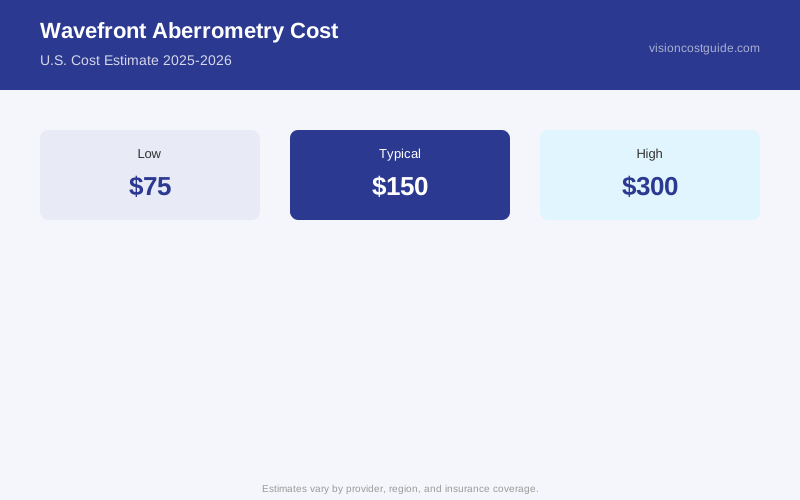
Standalone wavefront analysis (as a diagnostic test without surgery): $75–$200 depending on the practice. This is used when you have quality-of-vision complaints — halos, starbursts, ghosting — that you want quantified, or when you’re evaluating post-surgical outcomes.
As part of LASIK: Wavefront-guided LASIK (also called custom wavefront LASIK, iDesign, WaveScan) costs $150–$300 more per eye than conventional or wavefront-optimized LASIK. Total LASIK pricing typically:
| LASIK Type | Per Eye Cost | Per-Procedure Total (Both Eyes) |
|---|---|---|
| Conventional LASIK | $1,000–$1,800 | $2,000–$3,600 |
| Wavefront-optimized LASIK | $1,200–$2,000 | $2,400–$4,000 |
| Wavefront-guided LASIK | $1,400–$2,400 | $2,800–$4,800 |
See the LASIK eye surgery cost article for a complete breakdown of what’s included in these fees.
Wavefront-Guided vs. Wavefront-Optimized: The Difference
Wavefront-optimized LASIK corrects your prescription (lower-order aberrations) while adjusting the treatment at the corneal periphery to avoid inducing spherical aberration — the HOA that flat-plate laser ablation naturally introduces. It doesn’t measure or treat your pre-existing HOAs. Most standard LASIK offered today is wavefront-optimized.
Wavefront-guided LASIK measures your complete aberration profile (lower + higher order) and programs the laser to correct your individual HOA fingerprint, not just your prescription. It requires that your pre-existing HOAs are large enough to matter and that the cornea has enough thickness to accommodate the customized treatment.
A 2019 FDA-monitored study of iDesign wavefront-guided LASIK found that 88% of eyes achieved uncorrected distance acuity of 20/16 or better at 12 months — a benchmark that standard LASIK achieves in roughly 70–75% of eyes.
Wavefront-guided LASIK provides the most benefit for patients with:
- Large pupils (greater than 6–7mm in dim light) — more HOAs affect the visual field as the pupil expands
- Significant pre-existing HOAs — if you already have coma or trefoil beyond normal levels, a treatment that corrects only sphere and cylinder won’t address those
- History of previous refractive surgery (LASIK enhancement, PRK) — secondary treatments often involve irregular corneas with elevated HOAs
- Demanding visual quality requirements — pilots, surgeons, people who do significant night driving
Patients with small pupils, low pre-existing HOAs, and modest prescriptions may not see a meaningful difference between wavefront-guided and wavefront-optimized outcomes.
Does Insurance Cover Wavefront Aberrometry
No. LASIK and associated diagnostics are elective — not covered by medical or vision insurance. This includes wavefront analysis performed as part of LASIK candidacy evaluation.
Wavefront aberrometry performed as a standalone diagnostic test for non-elective indications (e.g., evaluating optical quality after accidental corneal injury, documenting HOAs in keratoconus management) may be covered by medical insurance with appropriate diagnosis codes. But this is uncommon — most aberrometry in clinical practice is tied to refractive surgery evaluation.
HSA and FSA funds can be used for LASIK and its associated testing, including wavefront aberrometry.
What the Wavefront Map Shows: Reading Your Results
A Zernike polynomial decomposition of your wavefront error produces a map with numerical coefficients for each aberration term. What matters clinically:
- RMS (Root Mean Square) error: The overall magnitude of aberration. Higher = more aberration. Anything above 0.3 microns of HOA RMS is considered significant.
- Spherical aberration (Z4,0): Naturally increases with age and is induced by conventional LASIK. Positive spherical aberration causes halos; negative causes other distortions.
- Coma (Z3,±1): Asymmetric blur — causes comet-like or streak-shaped distortions around point sources. Often elevated in early keratoconus.
- Trefoil (Z3,±3): Three-pointed star pattern from point light sources.
Most patients don’t need to interpret the map themselves. But understanding that these numbers describe your specific optical system — and that a wavefront-guided treatment is programmed to address them — helps explain why custom LASIK costs more and why it may or may not matter for your specific case.
Wavefront aberrometry results are sensitive to the measurement conditions — pupil size, tear film quality, and fixation all affect accuracy. A poor tear film from dry eye can produce spurious HOA results. If you’re considering wavefront-guided LASIK and you have dry eye, treat the dry eye thoroughly for 3–6 months before your candidacy evaluation. Dry-eye-related optical aberrations can resolve with treatment, and you want the wavefront map to reflect your eye’s true optical profile — not a surface artifact from inadequate tear film.
Bottom Line
Wavefront aberrometry as a standalone test costs $75–$200. As an add-on to LASIK, wavefront-guided treatment adds $150–$300 per eye over wavefront-optimized LASIK. Whether that’s worth it depends on your pre-existing HOA profile, pupil size, and how important pristine night vision is to your lifestyle. Large-pupil patients and those with significant pre-existing aberrations see a real benefit. People with small pupils and low HOAs may not notice a difference. Ask your surgeon to show you your wavefront measurement before deciding — the data should guide the conversation.