You just handed over $450 at your optometrist’s office for a pair of glasses. The frames say “Ray-Ban.” The lenses are polycarbonate with an anti-reflective coating. And a nagging voice in the back of your head wonders: how does this cost more than an iPad?
The answer involves one of the most concentrated monopolies in consumer goods — a combination of vertical integration, brand licensing, and retail markup that the optical industry has maintained for decades. Understanding it won’t immediately lower your bill, but it’ll help you make smarter buying decisions.
The Luxottica Problem
Essilor Luxottica — now called EssilorLuxottica after a 2018 merger — controls an extraordinary share of the global eyewear market. According to the company’s own financial disclosures, it manufactures or licenses frames under more than 80 brand names, including Ray-Ban, Oakley, Versace, Prada, Burberry, Coach, and dozens more.
The same company also owns major retail chains (LensCrafters, Pearle Vision, Target Optical), the two largest US vision insurance networks (EyeMed and Davis Vision), and one of the world’s largest prescription lens manufacturers (Essilor). From the insurance company that covers your visit, to the retail chain where you pick frames, to the lab that cuts your lenses — there’s a real chance EssilorLuxottica touches every part of your glasses purchase.
This vertical integration doesn’t make glasses bad. But it does limit price competition at nearly every step.
How Frames Are Actually Priced
| Frame Tier | Wholesale Cost | Retail Price | Typical Markup |
|---|---|---|---|
| House brand / private label | $5–$15 | $50–$120 | 6–10x |
| Licensed brand (Ray-Ban, Coach) | $20–$40 | $150–$300 | 5–8x |
| Designer (Versace, Prada, Dior) | $30–$60 | $300–$600 | 5–10x |
| Independent optical boutique brand | $30–$80 | $200–$500 | 3–6x |
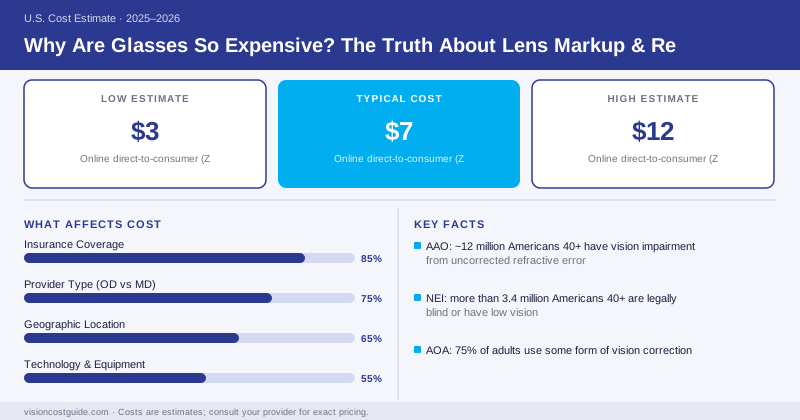
| Online direct-to-consumer (Zenni, EBD) | $3–$12 | $7–$50 | 2–4x |
A frame that retails for $200 at your eye doctor’s office typically cost the practice $20–$40 wholesale. That’s not dishonest — it covers office overhead, optician time, fitting service, and the ability to try frames on in person. But it’s worth knowing the economics when you’re deciding whether to buy in-office or online.
The Lens Markup Is Worse Than the Frame Markup
Frames get most of the attention, but lens pricing is where the real margin lives. Prescription lens blanks are manufactured by a small number of wholesale labs — Essilor (again), Hoya, Zeiss, and a few others control most of the supply. A high-index single-vision lens that a practice bills at $120–$180 may have cost the lab $15–$25 to produce.
Coatings add up fast. Anti-reflective coating: $40–$80. Scratch-resistant coating: $20–$40. UV coating: $20–$30. Photochromic treatment (transitions): $80–$150. Each coating adds a few dollars of real manufacturing cost and $30–$100 of retail cost.
Progressive lens premium. Premium progressive designs like Varilux X Series or Zeiss Individual retail at $400–$600 for lenses alone. Wholesale lens blank cost: $40–$80. The “design” premium is real — better progressive optics genuinely reduce swim and widen the reading zone — but the markup is substantial.
For many independent optometry practices, optical dispensing (selling glasses) generates 40–60% of practice revenue. The professional exam fee often barely covers overhead — the margin comes from the optical. This isn’t unethical, but it does create a structural incentive for in-office upselling on lens upgrades and coatings. Knowing this helps you evaluate whether the recommended upgrades are genuinely useful for your situation or primarily margin-driven.
Why Online Glasses Are So Much Cheaper
Zenni, EyeBuyDirect, Warby Parker, and Coastal buy frames in high volume directly from manufacturers — often the same factories that produce branded frames at much lower prices. They skip the retail optical overhead: no optician salaries, no premium lease, no frame inventory carrying costs. Zenni’s $6.95 frames are exactly what they sound like — functional, basic, lower-quality materials — but their $30–$50 frames are often genuinely comparable to a $150–$200 frame at a full-service optical.
The tradeoff is real: you can’t try them on, no one measures your pupillary distance in person, and there’s no fitting adjustment after they arrive. For simple prescriptions, that’s a reasonable trade. For complex prescriptions, progressive lenses, or anyone who needs precise optical center placement, the professional fitting service has legitimate value.
If you’re going to buy online glasses, measure your own PD (pupillary distance) accurately. Smartphone apps like GlassesUSA’s PD Measure or the EyeMeasure app give reasonable estimates. A 1mm error in PD placement creates a meaningful prismatic effect that causes eye strain — most noticeable in progressive lenses. Get it right.
How to Pay Less Without Compromising Quality
Use your vision insurance wisely. VSP and EyeMed allowances ($150–$200) are real money. Use them on frames you’d actually spend $150–$200 on, not on a $400 designer frame where you pay $200 out of pocket over the allowance for the brand name.
Buy your frames separately. Many online retailers let you order lenses in frames you already own. If you love a pair you found for $30 online, you can sometimes bring them to a local optician for lenses-only. Not all practices will do this, but some independent opticians will.
Ask about house brands. Most practices carry private-label frames that aren’t affiliated with EssilorLuxottica brands — the markup is lower and the quality is often equal to the branded frames on the same shelf.
Skip the coating bundles. AR coating on your primary pair is worth it. UV is usually built in to modern lens materials. The rest — scratch warranties, “blue light blocking” (minimal clinical evidence for benefit), and extended protection plans — are typically not worth the price.
See also: How to Get Cheap Eyeglasses for specific retailer comparisons and Online Glasses Cost for a full breakdown of online options.