42% of patients with xanthelasma have normal cholesterol levels. That’s the statistic that surprises most people — because xanthelasma (those yellowish cholesterol plaques on the inner upper or lower eyelid) looks metabolic, and sometimes it is, but nearly half the time your lipid panel comes back completely normal. What doesn’t change regardless of bloodwork: the deposits don’t go away on their own, and if they bother you cosmetically, you’re looking at a procedure to remove them.
Costs vary significantly depending on the treatment method, the number and size of lesions, and whether you see a dermatologist, oculoplastic surgeon, or ophthalmologist for the procedure.
What Xanthelasma Is — and Isn’t
Xanthelasmas are flat or slightly raised yellowish plaques of lipid-laden macrophages in the dermis of the periorbital skin. They’re most common at the medial (nasal) corners of the upper and lower eyelids. They’re not dangerous. They don’t affect vision unless extremely large. They don’t cause pain or inflammation.
But they grow slowly over time and can be psychologically distressing — patients frequently report being asked if they have a bruise or skin condition. A 2019 study in JAMA Dermatology found xanthelasma affects approximately 1.5% of adults, with higher prevalence in women and individuals of East Asian and South Asian descent.
Before treating, a lipid panel (cholesterol workup) is standard — if hyperlipidemia is present, treating the underlying condition won’t make the deposits disappear, but may slow recurrence after removal.
Treatment Methods and Costs
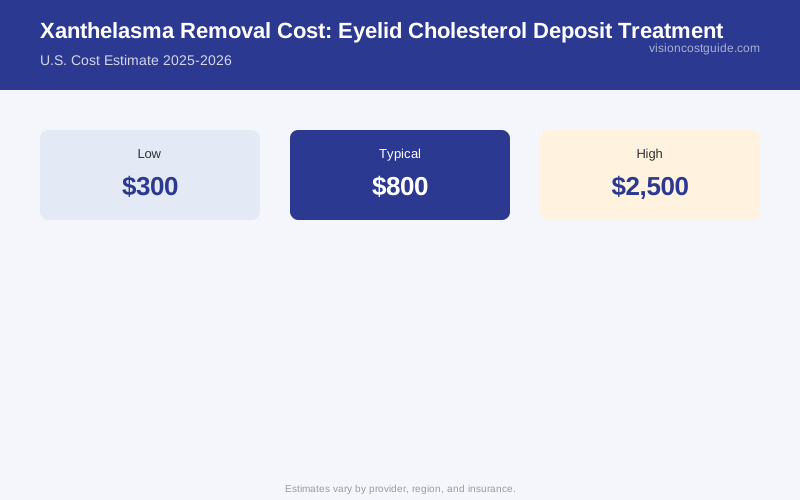
| Treatment | Low | Typical | High |
|---|---|---|---|
| TCA (trichloroacetic acid) chemical peel | $150 | $350 | $700 per session |
| CO2 fractional laser ablation | $400 | $750 | $1,500 per session |
| Er:YAG laser ablation | $350 | $700 | $1,200 per session |
| Surgical excision | $500 | $1,000 | $2,500 |
| Radiofrequency (RF) ablation | $300 | $600 | $1,000 per session |
| Cryotherapy | $150 | $300 | $600 per session |
| Consultation (ophthalmology/oculoplastics) | $150 | $250 | $400 |
TCA Peel: The Most Common Office Treatment
Trichloroacetic acid (TCA) applied at concentrations of 70–100% is the most widely used first-line treatment for xanthelasma. It’s inexpensive, requires no anesthesia or special equipment, and can be performed in a 15-minute office visit.
The acid causes superficial necrosis of the lipid deposits; the treated area crusts over and heals in 7–10 days. Multiple sessions are often needed for larger lesions — typically 2–4 treatments spaced 6–8 weeks apart. Cost per session runs $150–$700 depending on the practice. TCA works best for small, superficial lesions; deep or large xanthelasmas are better addressed with laser or surgery.
Recurrence rate after TCA: approximately 40–50% within 5 years — higher than surgery or CO2 laser, but the low cost and repeatability make it attractive for small lesions.
Laser Ablation: The Precision Option
CO2 and Er:YAG lasers ablate the xanthelasma tissue layer by layer with precision. The periorbital skin is delicate, and experienced hands can remove the deposit while minimizing damage to surrounding tissue. Local anesthetic cream or injection is used.
Laser is particularly useful for:
- Lesions near the eyelid margin where surgical excision risks eyelid retraction
- Patients who want minimal downtime (laser heals in 5–10 days vs. 2–3 weeks for surgery)
- Multiple small lesions that would require extensive surgery
A single laser session costs $400–$1,500 depending on lesion size and number. Larger or recurrent deposits may need 2 sessions. Recurrence rates for CO2 laser are approximately 25–40% at 5 years — better than TCA, not quite as good as surgical excision.
Xanthelasma removal is classified as cosmetic by virtually all insurers — medical insurance doesn’t cover it unless vision is actually impaired (extremely rare). That means you’re paying out of pocket for any removal procedure. The silver lining: the initial consultation with an ophthalmologist or oculoplastic surgeon to diagnose the lesions and check for underlying conditions may be covered as a medical visit. Code H02.60 (Xanthelasma of eyelid, unspecified) is the ICD-10 diagnosis code — the consultation component may be billable under medical insurance even when the removal itself isn’t.
Surgical Excision: Lowest Recurrence
Direct surgical excision under local anesthesia removes the xanthelasma deposit along with a thin margin of surrounding dermis, then closes the wound primarily (suture) or allows it to heal by secondary intention for very small lesions.
Recurrence rates are the lowest of any method — approximately 15–30% at 5 years. The tradeoff: surgical excision of larger lesions near the medial canthus can cause scarring, subtle ectropion (lid turning outward), or webbing across the inner corner. For small or medium lesions, these risks are minimal with an experienced oculoplastic surgeon. For large lesions covering significant eyelid area, surgery is the right choice despite the higher complexity.
Cost: $500–$2,500 depending on lesion size, number, and the surgeon’s fee structure. Most oculoplastic surgeons charge separately for each lesion when multiple are present.
Avoid DIY xanthelasma removal with online TCA kits. The periorbital skin is some of the thinnest on the body — 0.5mm around the eyes versus 2–3mm on the cheek. TCA at high concentrations applied by an untrained person to this area can cause permanent scarring, corneal injury if it contacts the eye surface, and ectropion from overtreatment. This is a case where the procedure is not technically complex for a trained provider, but extremely dangerous when self-administered. See a dermatologist or oculoplastic surgeon.
Choosing a Provider
Because xanthelasma sits at the intersection of dermatology and ophthalmology, you have several provider options:
- Oculoplastic surgeons (ASOPRS fellows): Best choice for lesions close to the eyelid margin or involving significant eyelid area — they understand eyelid anatomy and can prevent lid retraction
- Dermatologists with laser experience: Good for smaller, superficial lesions, especially when laser is the planned treatment
- General ophthalmologists: May offer TCA treatment; refer complex cases to oculoplastics
Get a consultation first — not every xanthelasma requires the same approach, and matching treatment to lesion characteristics (size, depth, location, number) determines both cosmetic outcome and recurrence risk.