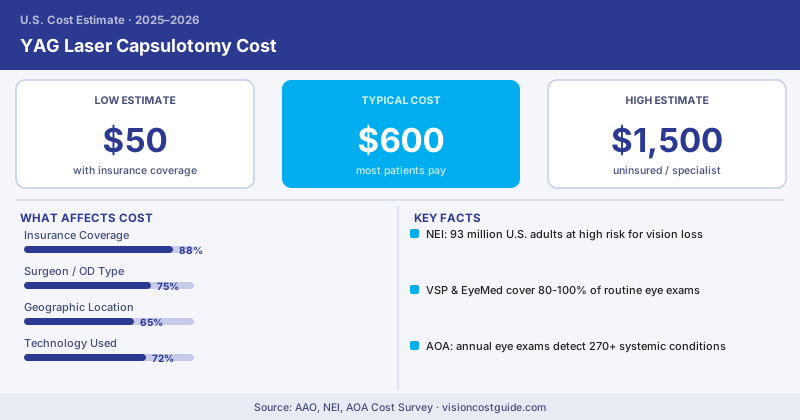
The $800 bill arrives about 18 months after your cataract surgery — and it throws a lot of patients off guard. You had the cataract removed, your vision was sharp, and then it turned foggy again. Now your ophthalmologist is recommending a YAG laser capsulotomy. What’s that going to cost?
Here’s the short answer: $300–$1,500 per eye, with most patients paying $400–$800 out-of-pocket after insurance. And if you have Medicare, it’s usually covered with a copay of around $40–$150.
What Is a YAG Laser Capsulotomy?
When your surgeon removes a cataract, the natural lens capsule (a thin membrane) is left in place to hold your new intraocular lens. Over time — usually 1 to 5 years after surgery — that capsule can turn hazy, a condition called posterior capsule opacification (PCO). The result: blurry vision that looks a lot like the original cataract coming back.
A YAG laser capsulotomy takes about 5 minutes in the office. Your ophthalmologist uses a YAG (yttrium-aluminum-garnet) laser to create a small opening in the cloudy capsule, and your vision typically clears within hours. According to the American Academy of Ophthalmology (AAO), PCO affects up to 20% of patients within 2 years of cataract surgery and up to 50% within 5 years — making YAG capsulotomy one of the most frequently performed laser eye procedures in the U.S.
How Much Does YAG Laser Capsulotomy Cost?
| Scenario | Typical Cost |
|---|---|
| With Medicare Part B | $40–$150 copay |
| With commercial insurance | $100–$400 copay |
| Uninsured / self-pay | $400–$1,500 per eye |
| Surgery center facility fee (uninsured) | $200–$600 additional |
| Ophthalmologist’s professional fee | $300–$900 |
The total bill often breaks into two parts: the physician’s professional fee and a facility or equipment fee if you’re in an ambulatory surgery center (ASC). Some ophthalmologists perform the procedure in-office, which typically lowers the total cost.
Does Insurance Cover YAG Laser Capsulotomy?
Yes — almost always. Because PCO is a complication of cataract surgery, YAG capsulotomy is treated as a medically necessary procedure rather than elective vision correction.
- Medicare Part B covers YAG capsulotomy at 80% of the approved amount after your deductible. With supplemental (Medigap) insurance, your out-of-pocket can be close to zero.
- Medicaid generally covers it, though prior authorization may be required.
- Private insurance: Most major commercial plans (Blue Cross, Aetna, Cigna, UnitedHealthcare) cover it under the medical benefit, not the vision benefit. This distinction matters — apply it to your medical deductible, not your vision copay.
YAG capsulotomy is billed under CPT code 66821. The facility fee uses an APC (ambulatory payment classification) code. If your insurer disputes the claim, make sure the EOB shows CPT 66821 — sometimes it’s miscoded as an elective refractive procedure, which would cause a denial.
What Affects the Cost?
Geographic location is a big one. Ophthalmologists in New York City or Los Angeles often charge 30–40% more than colleagues in smaller metro areas. A self-pay patient in rural Ohio might pay $350; the same procedure in Manhattan could run $900+.
Facility type matters too. An in-office laser system means no separate ASC fee. But if your doctor doesn’t own the laser and sends you to a surgery center, expect a facility charge of $200–$600 on top of the physician fee.
The laser equipment used can also vary. Most YAG systems produce comparable clinical outcomes, but some practices use newer platforms and pass along higher per-procedure costs.
The Procedure: No Preparation, No Downtime
Most patients are surprised by how easy the procedure is. You’ll sit at a slit lamp, your ophthalmologist will apply numbing drops (no injections needed), and then the laser does its work. The whole thing takes less than 10 minutes, including setup.
A few points to know beforehand:
- You’ll likely receive dilating drops, so bring sunglasses and don’t plan to drive afterward.
- Your eye pressure may spike temporarily. Your doctor will usually check IOP 30–60 minutes after the procedure.
- Vision may be slightly hazy for a few hours as the eye adjusts.
- Results are permanent — the capsule won’t cloud up again.
If you experience a sudden increase in floaters, flashes of light, or a curtain-like shadow after a YAG capsulotomy, contact your ophthalmologist immediately. Although rare, the procedure carries a very small risk of triggering retinal detachment — especially if you’re highly myopic (nearsighted). Don’t wait to see if symptoms resolve on their own.
How to Lower Your Cost
Use your medical insurance, not your vision plan. This is probably the most important tip. YAG capsulotomy is billed as a medical procedure — it may not count toward your vision deductible at all, but it will typically count toward your medical deductible.
Ask about in-office vs. ASC pricing. If your ophthalmologist offers both options, in-office is almost always cheaper for self-pay patients.
Check if you qualify for Medicare. The AAO reports that cataract surgery is the most common surgery performed on Medicare beneficiaries, with over 4 million procedures annually. A significant share of those patients eventually need a YAG capsulotomy — and Medicare is well-calibrated to cover it.
Request an itemized estimate. Before the procedure, ask your ophthalmologist’s billing team for a line-item quote. Some practices bundle the YAG fee into a “post-cataract care package” that may or may not be advantageous depending on your coverage.
Bottom Line
A YAG laser capsulotomy is quick, effective, and almost always covered by health insurance. If you have Medicare or a commercial medical plan, your out-of-pocket will typically be under $200. Uninsured patients should expect $400–$900 in most markets, with higher costs in major metro areas. The procedure has a near-100% success rate for restoring clarity — and once it’s done, it won’t need to be repeated.